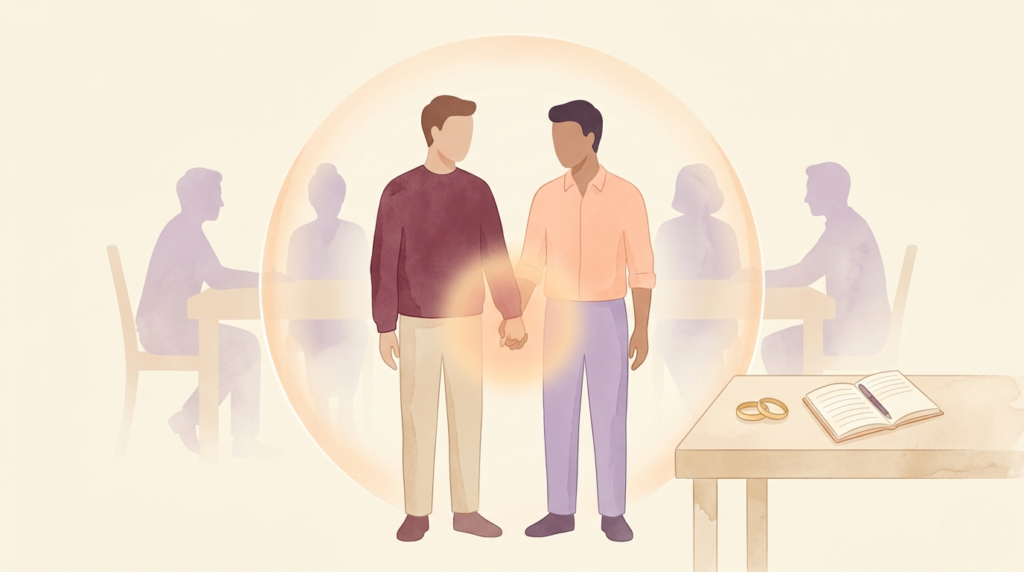
Same-sex marriage often becomes not only a decision of two people to be together but also a point where all family tensions surface: rejection, silence, pressure, fear of “what relatives will say,” attempts to devalue the relationship, refusal to acknowledge a partner, anxiety about the future, and the pain of having to explain love. For a couple, this can be especially difficult because the joyful decision about closeness, fidelity, and sharing life can turn into a negotiation field with other people’s expectations. This article examines why the topic of marriage in same-sex couples so often heightens family pressure, how partners can avoid losing each other in this tension, what boundaries help preserve dignity, and when the support of a psychologist becomes especially important.
Why marriage becomes a point of tension
In any relationship, the conversation about marriage brings up many emotions. It’s about the future, responsibility, intimacy, trust, shared living, family, money, moving, sometimes children, and legal security. But in a same-sex couple, marriage often carries another meaning: it makes the relationship more visible. What could be left in the shadows for years suddenly becomes hard to ignore.
As long as the partner is called a “friend,” the family can pretend that nothing is happening. As long as the relationship isn’t formalized, relatives can hope that “this will pass,” “this is not serious,” or “it’s just a phase.” But when the couple starts to talk about marriage, the illusion of temporariness crumbles. For families that do not accept LGBTQ+ relationships, this can become a moment of strong reaction.
That is why same-sex marriage can be both a source of joy and stress for the couple. On one hand, it’s the acknowledgment of love, the choice of each other, the desire to build a common future. On the other hand, it’s a confrontation with questions: whom to invite, whether to tell the parents, how to respond to rejection, what to do with relatives who devalue the relationship, how to withstand pressure without destroying the connection within the couple.
In the model of minority stress, described in the work Meyer, 2003, Psychological Bulletin, there is mention of additional chronic stress that people from stigmatized groups face. For a same-sex couple, marriage can amplify this stress: the anticipation of rejection, the need to choose the level of openness, confrontation with family attitudes, and internal stigma.
It is important to understand: if preparing for marriage causes anxiety, it does not mean that the couple is not ready to be together. Sometimes the anxiety is not about doubts regarding the partner, but about the relationship moving from a hidden space into a social field, where not everyone is ready to respect it.
A family that does not accept
Family rejection can look different. Sometimes it appears as open aggression: insults, threats, prohibitions, pressure, attempts to “convince,” accusations of destroying the family. But often rejection looks softer and, therefore, is more difficult to recognize. Parents say, “We love you, but not this,” “just don’t tell the relatives,” “why do you need marriage,” “don’t call it family,” “we don’t mind, we just don’t want to see it.”
Such phrases can hurt no less than a direct conflict. They carry a hidden message: you can be with us only in a diminished version of yourself. Your love is acceptable as long as it remains unnoticed. Your partner does not have the same place as the partners of other family members.
For the couple, this becomes a test. One partner may hope that the family will get used to it over time. The other may feel that their dignity is already being violated. One might fear losing their parents. The other might fear living their entire life as someone who is “tolerated” but not acknowledged.
In the recommendations of the American Psychological Association, Guidelines for Psychological Practice with Sexual Minority Persons, it is emphasized that professionals need to consider the social and family context of LGBTQ+ individuals. This is particularly important in the topic of marriage, as family pressure can affect not only individual well-being but also the dynamics of the couple.
Family rejection may evoke conflicting feelings in a person. Anger, shame, guilt, hope, fatigue, a desire to explain over and over again, a desire to withdraw, the fear of breaking the connection. All these feelings can coexist simultaneously. In therapy, it is essential not to choose one “correct” feeling but to allow room for the entire complexity.
It is important for a same-sex couple not to pretend that the family’s reaction does not matter. And not to give the family the power to determine how real the relationship is. Between these extremes lies a path: to acknowledge the pain, to see the limitations of loved ones, to build boundaries, and to gradually decide what role the family can play in the couple’s life.
Different paces of openness in the couple
One of the most common causes of tension around same-sex marriage is different paces of openness. One partner is already ready to talk about marriage, publish joint photos, invite friends, discuss the ceremony, and make plans openly. The other fears the reaction of parents, colleagues, relatives, or society.
This difference does not necessarily mean that one loves more and the other less. Often it is linked to different past experiences. One may have grown up in a more accepting environment, have already come out, and have the support of friends. The other may have faced threats, family control, religious pressure, or financial dependence. On the surface, this looks like a dispute about marriage. Internally, it can be a clash of two safety strategies.
The partner who desires openness may feel pain: “Why am I being hidden again?” “Why is family more important than us?” “Why should I be invisible?” The partner who is afraid may feel pressure: “I am being forced to take risks,” “I am not understood,” “If I lose my family, who will endure this with me?”
If the couple does not acknowledge both pains, the conversation quickly turns into accusations. One becomes the “coward,” while the other is the “selfish one.” One “is ashamed of the relationship,” while the other “disrespects the risks.” In such a logic, it becomes impossible to negotiate because each person is defending not only their position but also their pain.
A more gentle conversation begins with acknowledging two realities. “It hurts me to be invisible” and “I am scared of losing my family” can be true simultaneously. The couple’s task is not for one truth to prevail over the other, but to find a way where one person’s safety does not erase the other’s dignity.
Sometimes it helps to agree on intermediate steps. For example, first telling one safe relative. Or discussing in advance whom to invite to the ceremony. Or agreeing that the partner will not be presented as a “friend” where that is humiliating. Or creating a separate celebration for the accepting circle if the family is not ready yet. These steps do not solve everything at once, but they show that both partners are engaged in finding a solution.
Parental pressure and guilt
For many LGBTQ+ individuals, parental pressure becomes particularly strong in the context of marriage. While the relationship existed without a formal decision, parents could maintain hope that “everything will change.” But the conversation about marriage makes the choice more explicit. And then parents may feel the desire to regain control.
Pressure can sound like concern: “We worry about you,” “you will have a hard time,” “society will not accept you,” “you will ruin your life.” Sometimes there is genuine anxiety in these words. But parental anxiety does not always show respect for an adult child’s autonomy. Sometimes it becomes a way to keep them in a role that is convenient for the family.
Guilt in such situations can be overwhelming. A person may think: “I am hurting my parents,” “I am ruining their expectations,” “I have to be thankful,” “They’ve done so much for me,” “Maybe I should sacrifice my happiness for their peace of mind.”
It is important to differentiate between the parents’ pain and the adult person’s responsibility for their life. Parents may feel distressed. They have a right to their feelings. But their feelings should not automatically become a prohibition on your love, marriage, partnership, and future.
Guilt often intensifies where family boundaries have been blurred. If a child has been responsible for the parents’ emotional state since childhood, it may be difficult for them as an adult to choose themselves without feeling traitorous. A same-sex marriage is then experienced not as a personal decision but as a “blow to the family.”
In therapy, it is possible to gradually separate responsibility from guilt. You are not obliged to make your parents happy at the cost of your own life. You can respect their feelings while not giving them the right to decide whom you should love, with whom to build a marriage, and how to define your family.
How to talk about marriage with loved ones
The conversation about marriage with family does not have to be sudden and dramatic. Sometimes it’s helpful to prepare not only your words but also your internal stance in advance. What exactly do you want to convey? What are your expectations from your loved ones? What possible reactions are there? What will you do if you are met with attempts to persuade you otherwise, shame, or pressure?
It’s important not to start the conversation from a defensive position. If a person feels guilty in advance, they may try to justify themselves: “we don’t want to upset anyone,” “it’s not that serious,” “we’re normal.” But marriage does not require justification. You can speak calmly and directly: “We have decided to get married. This is an important step for us. We want you to know.”
If the family asks questions, it’s important to distinguish questions that come from a desire to understand and questions that serve as a form of pressure. “What does this marriage mean to you?” may be an attempt to connect. “Are you sure this isn’t a mistake?” may carry hidden doubts about your right to choose. “Why do you need to formalize this?” might sound neutral but could undermine the very idea of family.
Preparing boundaries in advance is helpful. For example: “I am willing to talk if the conversation is respectful.” “I am not ready to discuss whether my orientation is correct.” “We will not tolerate insults directed at my partner.” “If the conversation becomes humiliating, I will end it.”
It’s also important for same-sex couples to agree on matters between themselves in advance. Who speaks? What exactly is communicated? How do partners support each other after the conversation? What should be done if one relative accepts and another reacts aggressively? What if only one partner is invited? These agreements help the couple avoid chaos due to family reactions.
Not all conversations end with acceptance. Sometimes families ask for time. Sometimes they refuse to listen. Sometimes they react painfully. This does not mean you “didn’t say it correctly.” Sometimes a person cannot control their family’s reaction. They can only control their honesty, boundaries, and self-care after the conversation.
Boundaries that protect the couple
Boundaries in the context of same-sex marriage are needed not to punish the family. They are necessary so that the couple’s relationship does not crumble under constant external pressure. Without boundaries, relatives can inadvertently or intentionally become a third force that manages the mood, plans, and safety of the partners.
The first boundary is not to allow the partner to be devalued. Even if the family is “not ready,” it does not mean they have the right to humiliate, ignore their name, talk about the person as a temporary mistake, or prohibit mentioning them in significant contexts.
The second boundary is not to discuss the right of the couple to marry as a subject for a vote. Loved ones may have feelings, questions, fears. But the couple’s decision to be together should not become a family referendum. An adult couple is not required to seek permission for their life.
The third boundary is not to agree to invisibility at any cost. Sometimes caution is needed, but if it becomes a permanent rule, one of the partners may become emotionally drained. It’s important to discuss where invisibility is genuinely related to risk and where it maintains someone else’s comfort at the expense of the couple’s pain.
The fourth boundary is to protect important events. If a wedding or ceremony turns into a place where the couple has to please all relatives, joy can disappear. Sometimes it’s better to have fewer people but more safety. Sometimes it’s important to choose those who are capable of respecting your union, even if they don’t fully understand it.
The fifth boundary is not to involve the partner in endless negotiations with your family without their consent. If it’s your family, your task is not to leave your partner alone to deal with their rejection. The couple’s support begins with a clear position: “This is my partner, and I won’t allow anyone to speak about them in a degrading manner.”
Boundaries may provoke protest. Especially in families accustomed to control. But protest does not mean that the boundary is wrong. Sometimes it is this boundary that first shows: our couple exists, and it ought to be treated with respect.
How partners can support each other
Family pressure becomes heavier if partners start to fight each other instead of recognizing the shared stress. One says, “You’re not protecting me.” The other responds, “You don’t understand how scared I am.” Both are right in their pain, but if each remains solely in their position, the couple loses their solidarity.
Support begins with recognition. It’s not essential to fully understand a partner’s experience to acknowledge their reality. “I see that it hurts you to be invisible.” “I see that you are afraid of losing your parents.” “I understand that for you, marriage is associated with safety.” “I understand that for you, marriage is associated with risk.” These phrases do not solve the problem, but they restore the partners’ sense of not being enemies.
It’s important not to demand an ideal reaction from your partner. A person under family pressure may shut down, become angry, avoid conversations, or postpone decisions. This does not always mean indifference. But if avoidance continues for a long time, the second partner has the right to express their pain.
It can be beneficial for the couple to create their own rituals of acknowledgment. Especially if the family does not support them. This could be a small ceremony for close friends only, a joint letter to each other, a day the couple celebrates as their own, a joint decision about surname, rings, home, trip, or photos. Such rituals help relationships not to rely entirely on the family’s reaction.
Another important element of support is a joint plan. What do we do if one partner’s parents refuse to come? What do we do if they require not inviting the second? What do we do if relatives send insults? What do we do after a difficult conversation? When there is a plan, the couple falls less into chaos.
And most importantly: partners need to remember that marriage is between them, not between them and the family. The family can be part of the celebration and life if they can respect the couple. But they should not become the principal judge of the relationship.
When therapy is needed
Therapy can be helpful if the subject of marriage has become a source of ongoing quarrels, anxiety, resentment, or silence. For example, one partner wants to move toward marriage, while the other avoids the conversation. One desires openness, while the other fears it. One feels invisible, while the other feels pressure. The couple keeps returning to one topic but cannot agree without pain.
Individual therapy helps a person deal with their guilt, fear of family, internal stigma, anxiety about coming out, rejection experiences, and the complexity of setting boundaries. Sometimes, before discussing marriage with the family, a person needs to strengthen their internal position: “I have the right to my life.”
Couples therapy is helpful if family pressure is already influencing the relationship. A psychologist can help partners hear not only their positions but also their fears. Not “you are hiding me,” but “it hurts me not to have a place in your life.” Not “you are making me take risks,” but “I am scared to lose connection with my family.” Such translation does not make the problem easy but makes the conversation less destructive.
For a same-sex couple, it is important to choose an LGBTQ+ friendly specialist. If a psychologist does not understand the context of minority stress, coming out, invisibility, family rejection, and same-sex marriage, they might give harmful advice: “it’s better not to upset the parents,” “why do you need to formalize this,” “don’t advertise it.” Such phrases can amplify shame and further divide partners.
Therapy should not push the couple toward a single correct solution. Not everyone is obliged to have a public wedding. Not everyone must invite family. Not everyone is required to sever ties with parents. The goal of therapy is to help the couple see real risks, desires, boundaries, pain, and resources, and then make a more conscious decision.
Sometimes therapy becomes a place where a person can first say: “I want marriage, but I am scared.” Or: “I am tired of being invisible.” Or: “I love my parents, but I can no longer live only by their expectations.” These phrases can mark the beginning of a discussion not only about marriage but also of a more adult position in one’s own life.
Marriage as a choice of the couple, not an exam for the family
Same-sex marriage often becomes a test not only for the family but also for the couple itself. Not in terms of “will you withstand or not,” but in the sense of: can you talk about fear, pain, visibility, boundaries, and the future such that you do not become enemies to one another.
Family pressure can be strong. It can touch the deepest layers: the need for parental love, fear of rejection, guilt, hope to be accepted, the pain of loved ones not seeing your life as a whole. But family pressure should not automatically become the primary law of your couple.
Marriage is a decision between two adult people. The family can rejoice, resist, acclimatize, ask questions, make mistakes, or ask for time. But it has no right to devalue your love, humiliate your partner, or turn your future into a matter of bargaining.
It is important for the couple not to demand perfect courage from themselves. Sometimes the path to marriage goes through fear, pauses, difficult conversations, tears, anger, and gradual boundary-setting. This does not make your choice any less real. On the contrary, it is often through such conversations that the couple better understands what it means to be together.
Support in the context of same-sex marriage is needed not to “defeat” the family. It is needed to avoid losing oneself and each other. To ensure that love does not become a constant defense. To make marriage not just a reaction to pressure but a conscious choice of a couple that has the right to respect, a future, and its own definition of family.
Frequently asked questions
Why does the topic of same-sex marriage evoke such strong family pressure?
Because marriage makes relationships more visible and stable. A family that could previously consider the relationship temporary or not notice it faces the reality of the couple’s adult choice.
What to do if parents do not accept same-sex marriage?
It is important to acknowledge your pain, not to try endlessly to earn acceptance, and to gradually establish boundaries. You can talk to your parents if the conversation is respectful, but you should not agree to humiliate your partner or devalue the relationship.
Should you invite family to the wedding if they do not accept the couple?
There is no single correct answer. It is important to assess whether the family’s presence will support or cause humiliation and tension. Sometimes, it is safer to choose a smaller circle of people but maintain respect for the couple.
What to do if one partner wants openness while the other is afraid?
It is necessary to discuss both sides: the pain of invisibility and the fear of consequences. Intermediate steps, honest agreements, and recognition that one person’s safety should not erase the other’s dignity can be helpful.
How to cope with feelings of guilt towards parents?
It is important to separate the parents’ feelings from your responsibility for your own life. Parents may feel distressed, but their feelings do not give them the right to decide whom you should love and with whom to build a marriage.
Can a psychologist help before talking to the family?
Yes. In therapy, you can prepare for the conversation, discuss fears, possible reactions, boundaries, words, support after the conversation, and your internal position.
Is couples therapy suitable for same-sex couples before marriage?
Yes. Couples therapy can help discuss openness, family, boundaries, marriage, future, legal and emotional issues, as well as reduce tension between partners.
{“@context”:”https://schema.org”,”@type”:”FAQPage”,”mainEntity”:[{“@type”:”Question”,”name”:”Why does the topic of same-sex marriage evoke such strong family pressure?”,”acceptedAnswer”:{“@type”:”Answer”,”text”:”Because marriage makes relationships more visible and stable. A family that could previously consider the relationship temporary or not notice it faces the reality of the couple’s adult choice.”}},{“@type”:”Question”,”name”:”What to do if parents do not accept same-sex marriage?”,”acceptedAnswer”:{“@type”:”Answer”,”text”:”It is important to acknowledge your pain, not to try endlessly to earn acceptance, and to gradually establish boundaries. You can talk to your parents if the conversation is respectful, but you should not agree to humiliate your partner or devalue the relationship.”}},{“@type”:”Question”,”name”:”Should you invite family to the wedding if they do not accept the couple?”,”acceptedAnswer”:{“@type”:”Answer”,”text”:”There is no single correct answer. It is important to assess whether the family’s presence will support or cause humiliation and tension. Sometimes, it is safer to choose a smaller circle of people but maintain respect for the couple.”}},{“@type”:”Question”,”name”:”What to do if one partner wants openness while the other is afraid?”,”acceptedAnswer”:{“@type”:”Answer”,”text”:”It is necessary to discuss both sides: the pain of invisibility and the fear of consequences. Intermediate steps, honest agreements, and recognition that one person’s safety should not erase the other’s dignity can be helpful.”}},{“@type”:”Question”,”name”:”How to cope with feelings of guilt towards parents?”,”acceptedAnswer”:{“@type”:”Answer”,”text”:”It is important to separate the parents’ feelings from your responsibility for your own life. Parents may feel distressed, but their feelings do not give them the right to decide whom you should love and with whom to build a marriage.”}},{“@type”:”Question”,”name”:”Can a psychologist help before talking to the family?”,”acceptedAnswer”:{“@type”:”Answer”,”text”:”Yes. In therapy, you can prepare for the conversation, discuss fears, possible reactions, boundaries, words, support after the conversation, and your internal position.”}},{“@type”:”Question”,”name”:”Is couples therapy suitable for same-sex couples before marriage?”,”acceptedAnswer”:{“@type”:”Answer”,”text”:”Yes. Couples therapy can help discuss openness, family, boundaries, marriage, future, legal and emotional issues, as well as reduce tension between partners.”}}]}