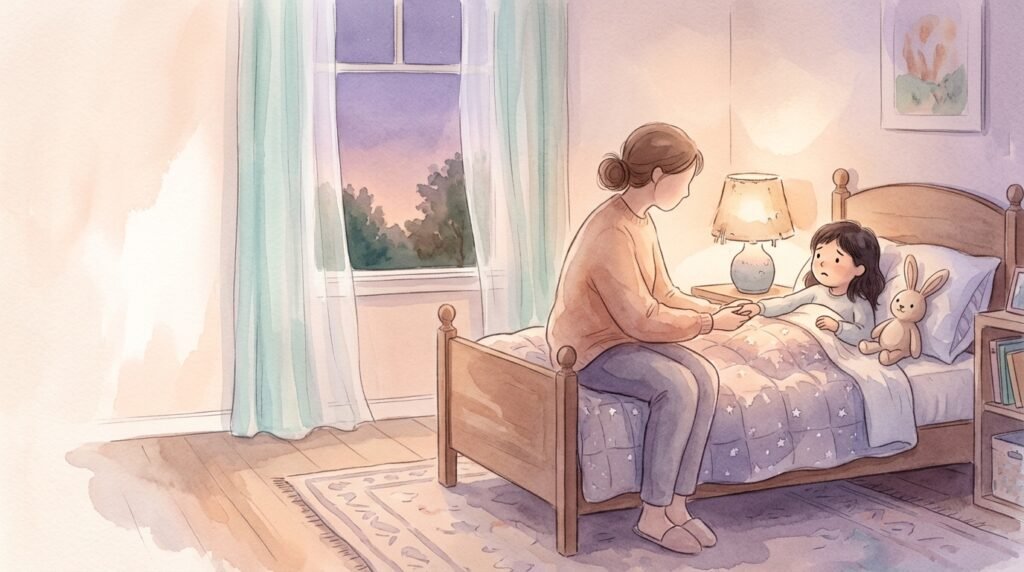
Sometimes a child’s anxiety is immediately visible: crying when separating at kindergarten, fear of joining a new group, long negotiations to leave the house. Sometimes it hides — in bedtime tantrums, in stomach aches in the mornings, in endless questions of “what if…?” to which you no longer have the strength to respond calmly.
Somewhere in the background lives another thought: “What if my own anxiety is the reason my child is so anxious?” This can feel especially heavy and shameful: you want to help, but any move you make seems either too harsh or too soft.
In this article, I invite you to view children’s anxiety as an understandable, living process rather than a “terrible problem.” Let’s explore what is more likely to amplify anxiety in children and what helps to reduce it. Most importantly — how to support your child without letting your own anxiety completely control your reactions.
Where does an anxious child come from
The phrase “anxious child” sounds like a diagnosis, although in reality it often refers to a combination of several reasons. These can be conditionally divided into three groups: the child’s characteristics, family context, and current stressors/events.
1. Features of the nervous system. Some children are more sensitive and are slower to “warm up,” needing more time to adapt to new things. Some easily go to kindergarten, while others physically struggle to enter an unfamiliar group — their heart races, their palms sweat, and tears come naturally. This is not whimsy, but a real, varied “tuning” of the body.
2. Family atmosphere and communication style. If anxious phrases are often heard at home (“be careful!”, “it’s dangerous there!”, “better not go”), with a lot of unpredictability or conflict, the child may learn to see the world as an unsafe place. Even if they are cared for, the general atmosphere may be perceived as “you need to be on guard all the time.”
3. Life events and pressures. Moving, divorce, the birth of younger siblings, illnesses, starting kindergarten or school, bullying, frequent changes in caregivers — all these can heighten children’s anxiety. At some point, you may notice that your child is afraid of everything, whereas they used to seem braver.
Most often, anxiety in children is not due to “one big reason,” but a weaving together of these threads. It is important to recognize that in any of them, you still have space to influence: not for self-blame, but for small, concrete steps.
Normal fears and anxiety that has become difficult
Fears in children are a natural part of development. Some come and go almost unnoticed, while others linger for a long time and begin to interfere with life. Sometimes it can be difficult to understand where the line is drawn.
Examples of age-related fears that are often considered normal:
- up to three years — fear of separation from close adults, loud sounds, unfamiliar people;
- 3–5 years — fear of the dark, “monsters,” certain animals, fantasy fears of death;
- early school age — fear of getting a bad grade, being late, embarrassing oneself in front of the class;
- teenagers — fear of peer judgment, rejection, loss of status, physical changes.
Typically, such fears fluctuate, becoming stronger or weaker and gradually being replaced by new challenges. Anxiety raises more questions when it:
- is very frequent and intense — the child almost every day expects something bad;
- limits life — refuses to go to kindergarten, outside, classes, only falls asleep with you;
- is accompanied by physical symptoms — frequent complaints about the stomach, head, nausea without medical reasons;
- leads to marked avoidance — the child doesn’t try new things, categorically refuses to engage;
- lasts for months without noticeable breaks or gradually intensifies.
This is not a checklist for self-diagnosis, but a guideline: if you note several of these points in an anxious child simultaneously, it is worth paying closer attention and perhaps discussing it with a specialist. But even with “ordinary” childhood anxiety, how you respond can greatly ease life for both your child and yourself.
The role of the parent: you are not the cause of the “breakdown,” you are part of the system
The thought “I messed everything up, it’s because of us that he is like this” is paralyzing. When a parent completely blames themselves, their strength goes not to caring, but to self-punishment. At the same time, the influence of adults is indeed significant — but this influence can be wielded differently.
I would suggest viewing the family as a living system. All influences within it are mutual: the child picks up on your tone, gestures, pauses; you sense their tears, silence, resistance. In this circular dynamic, one can find points of change without devaluing oneself.
What a parent can do regarding children’s anxiety:
- notice in which situations children’s anxiety intensifies and where it decreases;
- change your parenting strategies if you feel they are exacerbating the situation (for example, excessive strictness or overprotection);
- learn to talk about fears and mistakes differently — without dramatization and without saying “oh, what nonsense”;
- support predictability and clear rules at home to reduce the overall anxiety level;
- take care of your own state to avoid “infecting” your child with constant anxiety.
You are not obligated to become an ideal, always calm and confident adult. It is enough to gradually become a little more stable than your child, a little more predictable and accepting. That is already a lot.
What usually increases anxiety in children
When there is an anxious child nearby, adults often swing to two extremes: “we need to toughen them up, they should stop being afraid” or “we need to protect them, so they won’t be traumatized.” Both of these can inadvertently amplify children’s anxiety.
1. Devaluation and shame. Phrases like “come on, stop acting like a baby,” “there’s nothing to be afraid of,” “don’t make things up” do not diminish fear. The child continues to feel it, but now a layer of shame is added: “there’s something wrong with me.” Ultimately, they either cling to you even more tightly or learn to hide their feelings.
2. Dramatization and excessive sympathy. The opposite extreme is when any fear is met with your horror: “Oh my God, poor you, how scared you must be! What a nightmare!” The message then sounds like this: “something huge and terrible is happening, I’m terrified myself.” The child receives the signal that their feelings are too strong, and the threat is very great.
3. Overprotection and avoidance. When a child is afraid of everything, there is a strong desire to remove all potentially scary situations from their path. Not going to birthday parties, not leaving them at kindergarten, not taking them to the doctor, not asking them to stay with their grandmother… In the short term, this provides relief, but in the long term, it reinforces the belief: “I can’t handle it, the world is dangerous, it’s better not to go anywhere at all.”
You can read more about overprotection and its influence on children’s anxiety in another blog article: what is overprotection.
4. Inconsistency. Today you persuade your child to go to kindergarten, tomorrow you keep them home at the first sign of distress, the day after you get angry and force them to go. The child finds it hard to understand what is considered normal and what is an exception. This intensifies the feeling of unpredictability, and thus anxiety.
5. Comparisons and labels. “Look, Masha isn’t scared,” “you are such a coward,” “another tantrum.” Even if you say this in despair, the child remembers this description of themselves and begins to view anxiety as a part of their identity, with which nothing can be done.
What helps an anxious child feel more calm
Helping an anxious child does not mean constantly calming them down. Rather, it’s about teaching them to notice, name, and manage their feelings, relying on you. Here are a few directions that often prove helpful.
1. Predictability and rituals. Children’s anxiety decreases when the world around them becomes more understandable. Helpful elements include:
- similar times and order of events in the morning and evening;
- short farewell and greeting rituals (hug, phrase, small gesture);
- preliminary “day routes”: who comes after whom, what will generally happen.
This is not about a strict schedule, but about the feeling “I know what to expect.”
2. Language for feelings. When a child has a vocabulary for their states (“I’m worried,” “I’m scared,” “I’m confused”), fears become a bit less frightening. You can learn this together. Games, books, discussing cartoons, and calm “cold” conversations — not during a tantrum, but later — can help.
If you’re looking for more ideas, you can check out the blog post on how to talk to a child about feelings.
3. Support instead of solving problems for the child. The difference is subtle. “Don’t be scared, everything is fine” — is about denying the feeling. Whereas “yes, it’s scary right now, I’m with you, let’s think about what could help” — is about recognition and finding support. Sometimes, it’s enough to just sit nearby without rushing or asking too many questions.
4. Small steps towards the frightening. If a child fears everything, especially new experiences, it’s useful not to throw them “into the deep end” but to build gradual steps. For example:
- first approach the kindergarten and simply look at the playground;
- on another day, go in for five minutes and step out together;
- gradually increase the time while staying in contact with the caregivers.
The key in such “steps” is a coordinated plan and your calm accompaniment, not forcing them at any cost.
5. Warm boundaries. Paradoxically, an anxious child feels calmer when there are clear “can do” and “cannot do” rules, rather than when their fears always dictate the rules. For example: “I see that you are scared to go to the doctor, but we are still going. I will be with you and help as much as I can.” The boundary remains, but the child is not left alone with their feeling.
How to calm a child here and now
When a child is crying, screaming, or frozen in fear, theoretical knowledge flies out of your head. It is helpful to have a few simple anchors to which you can mentally return.
1. First — your breathing. Before you speak, pay attention to yourself. A couple of slightly slower exhales, a sense of your feet on the floor, looking around: “where am I, what is happening right now.” This returns you to a minimal presence, and along with it — the ability to be supportive.
2. Body, not logic. In the midst of excitement, a child’s brain poorly absorbs explanations. Much more useful is gentle physical contact (if it is acceptable for both of you): a hug, a hand on their back, breathing together “in sync.”
You can use simple phrases:
- “I’m here, you are safe, we will think together about what to do next”;
- “Let’s breathe together. Inhale, exhale. I’m with you”;
- “You are very scared, it’s really scary. Right now we will just sit together.”
3. Grounding through sensations. Some children find it helpful to focus on what is happening here and now: “Look at our chairs. Touch the armrest. Is it hard or soft? What do you hear? What do you see?” This is not a magic technique, but a way to remind the body and brain that there is no real catastrophe happening right now, just a strong feeling.
4. Returning to the situation afterward. Once the emotional wave has subsided, you can calmly discuss what happened. Briefly, without interrogation: “Can you tell me when it became the scariest?” — “What helped you even a little?” — “Let’s think about what we can do next time.” This way, the child begins to see the connection between fear and how to deal with it.
When a child “catches” your anxiety
Even if you never vocalize your fears, children can surprisingly pick up on adults’ moods. Sighs, intonations, pauses, abrupt movements, constant background news — all these shape the atmosphere.
How parental anxiety may manifest for a child:
- you frequently check messages from the child or caregivers;
- you ask a lot: “is everything okay? did anything happen?”;
- you discuss dangers (illnesses, war, crimes) at length in front of children;
- you react strongly to every scratch or mistake;
- you avoid any risks associated with the child’s independence.
The child may conclude: “the world is dangerous if adults worry like this,” even if you haven’t stated it directly. This is not a reason to blame yourself, but a good signal to check your own state.
Sometimes it’s helpful to start with a question to yourself: “What am I most afraid of in this situation? What happens to me when the child cries/goes to kindergarten/ is left without me?” It may happen that your childhood fears, experiences of rejection, or your own unbearable feelings resurface in response. In this case, working on your own anxiety becomes not a luxury but an important part of helping the child.
There is a separate article on how adults can differently manage their anxiety: how adults can cope with anxiety.
Boundaries and support: being nearby without dissolving
When anxiety overwhelms a child, and then you as well, it is easy to fall into the trap: to give up all your needs and adapt life only to their fears. For a time, this might work, but in the long run, it exhausts everyone.
The task is not to disappear as a separate person, but to remain a support. This means:
- having the right to your own boundaries (“I can’t sleep right next to you every night, but I can sit with you until you fall asleep”);
- sharing responsibility (“I hear you are very scared to perform, let’s think together about how to make this happen, but completely avoiding it is not an option”);
- recognizing your own feelings without projecting them onto the child (“I am worried too, but we’ll manage, let’s take it step by step”);
- allowing space for your own life, rest, work, and communication — as much as is possible in your situation.
Sometimes it is helpful to ask yourself: “If I do what the child asks now, will it help them feel braver and freer in the future? Or will it reinforce the idea that they cannot manage without me?” There is no universal answer. The answer depends on age, context, and the frequency of the situation. Simply contemplating the question helps to break free from automatic reactions.
When child-parent therapy can help
Sometimes the family’s resources are sufficient to gradually cope with children’s anxiety on their own. Sometimes, despite efforts, anxiety only increases: the child avoids more and more, night after night you fall asleep together, any changes lead to meltdowns, and you have less and less patience and strength.
Triggers for considering professional support can be situations when:
- anxiety severely limits the child’s daily life (kindergarten, school, communication, sleep);
- you feel that you are constantly balancing between overprotection and harshness and cannot find a middle ground;
- the family is undergoing significant changes (divorce, moving, serious illness), and you fear that the child “won’t cope”;
- you notice yourself experiencing strong anxiety, irritability, exhaustion, and this already interferes with being the adult you want to be around the child.
In child-parent therapy, the focus is typically not only on the child but also on how your relationships are structured, what habitual “reaction circles” you have, and how you both experience fear and separation. It is not about finding blame, but about discovering new ways to be together.
If you feel that managing this alone is too hard right now, consider consulting regarding child-parent relationships. You can find more details about such a format and the options for seeking support on the service page: child-parent relationship therapy.
This material helps orient in the topic but does not replace an personal consultation and assessment of your situation. If you feel unsafe or are struggling significantly right now, seek support from a specialist or local emergency service.
Frequently Asked Questions
How can I tell if my child has more than just fears, but high anxiety?
A signal may be a combination of signs: frequent expectations of bad outcomes, intense reactions to minor issues, marked avoidance (refusing to go to kindergarten, not wanting to go anywhere), physical complaints without medical reasons, and duration — weeks and months without improvements. If this is interfering with family life, it is advisable to consult a specialist.
Should I tell my child that they are anxious?
It’s better not to label the child as “anxious,” but to talk about feelings: “You are feeling anxious right now,” “You find it hard with new people.” Labels like “coward” or “panic-prone” can cement anxiety as part of their identity. Supporting descriptive language helps the child see this as a state rather than their essence.
How can I calm my child before kindergarten or school?
Short farewell rituals (hug, phrase, gesture), a preliminary discussion about how the day will go, and recognition of feelings can help: “I see that you’re feeling anxious. I’ll be back after lunch.” It’s important to be consistent: if you’ve decided that the child goes to kindergarten, try not to cancel at every cry, but to accompany them through the experience.
Can you “overlove” an anxious child and intensify their fears?
Warmth by itself does not heighten anxiety. Anxiety is more likely to increase where there is much overprotection (when everything is decided for the child), a lack of clear boundaries, and a very anxious adult. Love that includes acceptance and clear rules usually helps rather than hinders.
Should I force my child to do what they are afraid of?
Forced “toughening up” may only amplify fear and undermine trust. A more effective approach is to take small steps towards the frightening situation with your supportive presence and clear boundaries: “We are doing this, but I am with you, and we will take it gradually.”
How should I talk to my child about scary news and events?
Consider the child’s age and their questions. Avoid overwhelming them with details, but also do not say “nothing is happening” if they are clearly feeling tension. Calmly explain in accessible language while assuring them that there are adults nearby who care for them and that they can come to you with any questions.
Will child psychotherapy help if I am a very anxious adult myself?
Working only with the child may alleviate some symptoms, but in the long term, it is more beneficial to involve the adult as well: family sessions, parent consultations, working on their own anxiety. You are an important part of the system, and your state significantly impacts the dynamic.