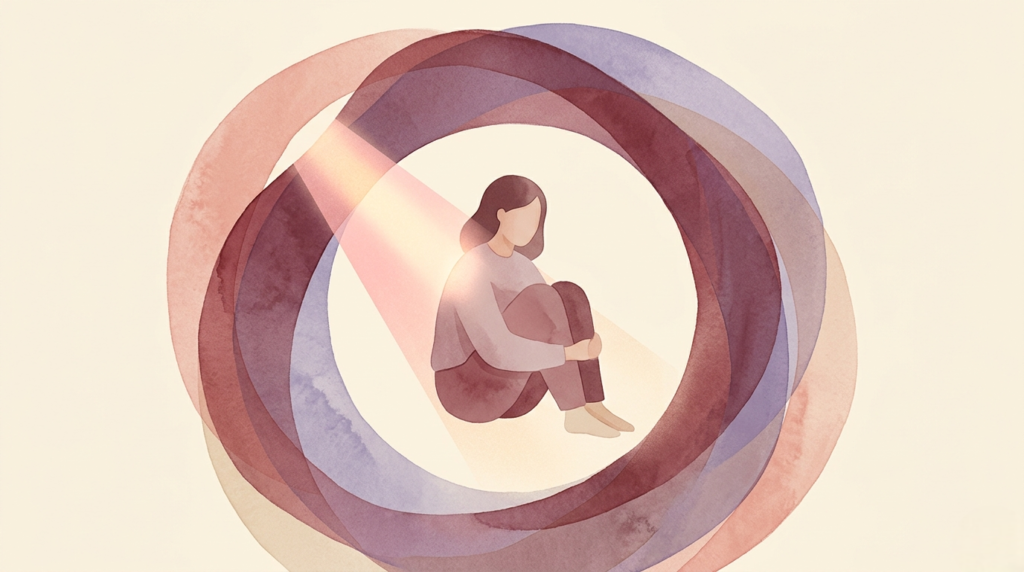
Why This Anxiety Is Not Accidental
When an LGBTQ+ person says, “I’m constantly tense,” it doesn’t always mean generalized anxiety in the classic everyday sense. Sometimes, it is the result of a long experience of living in an environment where a part of their identity had to be hidden, explained, defended, or internally controlled.
Anxiety can begin long before the first coming out. A teenager may not yet know the words “gay,” “lesbian,” “bisexual,” “queer,” “transgender,” or “non-binary,” but they already feel that certain topics are dangerous. They hear jokes, condemning phrases, family expectations, religious prohibitions, school aggression, or the silence of adults. Even if there was no direct violence, the psyche learns: “It’s better not to show this part of myself.”
Thus, a habit of living with an internal filter is formed. What can be said? What is better to hide? How will they react? Can I relax? The more such questions there are, the less free space there is inside. A person may appear composed, successful, calm, but their nervous system is functioning in a constant safety-check mode.
Importantly: such anxiety does not indicate weakness. It shows that the psyche has been doing protective work for a long time. When the environment is unsafe or unpredictable, anxiety becomes a means of survival. The problem arises when real danger diminishes, but the body and mind continue to live as if the threat is still present.
Minority Stress: When the Environment Becomes a Source of Tension
One of the key scientific models explaining mental tension in LGBTQ+ people is called minority stress. In the classic work by Meyer, 2003, Psychological Bulletin, it describes how people from stigmatized groups face not only regular life stress but also an additional level of pressure: discrimination, expectation of rejection, the necessity of hiding, and internal stigma.
This model is important because it alleviates false guilt from a person. If an LGBTQ+ client experiences anxiety, it is not necessarily a “personal character flaw.” It may be a logical reaction to an environment where their identity has long been perceived as something dangerous, controversial, or undesirable.
Minority stress includes several levels. The first level consists of external events: bullying, discrimination, insults, family rejection, mockery, threats, and the rejection of a partner. The second level involves the expectation of such events: a person prepares for negative reactions in advance, even if they haven’t happened yet. The third level is secrecy: the necessity of constantly deciding whom one can tell the truth. The fourth level is internal stigma: when external condemnation gradually becomes an internal voice.
Particularly destructive is the fact that these processes can be chronic. Ordinary stress has a beginning and an end. For example, an exam, a move, a conflict at work. Minority stress often lacks clear boundaries. It can accompany a person at home, work, in a doctor’s office, in relationships, on social media, during casual conversations with strangers.
In the recommendations of the American Psychological Association, Guidelines for Psychological Practice with Sexual Minority Persons, it is emphasized that psychologists must consider not only the individual history of the client but also the social context in which their identity was formed. Otherwise, there is a risk of mistakenly viewing anxiety as an isolated symptom, failing to see that it has arisen from years of adapting to an unsafe environment.
Shame as Internal Surveillance
Shame is different from guilt. Guilt says, “I did something wrong.” Shame says, “There’s something wrong with me.” For LGBTQ+ people, it is often this second variant that becomes the most painful.
A person may not encounter direct rejection every day, but already an internalized message lives within: “My feelings are wrong,” “My love is uncomfortable,” “I can’t talk about myself openly,” “If they find out, they’ll stop respecting me.” Such shame can be quiet, almost unnoticeable, but it affects self-esteem, relationships, sexuality, partner choice, career, and the ability to ask for support.
Research shows that shame plays a significant role in mental health disparities among sexual minorities. In the work by Pachankis et al., 2023, shame is considered one of the mechanisms through which sexual stigma can influence psychological state.
Shame often disguises itself as rational explanations. “I just don’t like talking about personal matters.” “I don’t need a relationship.” “I don’t want to burden anyone.” “I’ll manage on my own.” Sometimes, this is indeed a personal choice. But at other times, what lies beneath is not freedom but fear of being seen.
It is important not to attack one’s shame. It didn’t appear out of nowhere. Shame once could serve to protect: it helped not to stand out, not to say too much, not to attract attention, not to provoke a dangerous reaction. But if it continues to control life in adulthood, a person gradually loses contact with their desires, body, intimacy, and the right to be themselves.
Secrecy and Expectation of Rejection
Secrecy is often perceived as a solution: “I’ll just not tell anyone, and it will be calmer.” But the psyche pays a high price for constant hiding. One must remember whom they’ve told what. One must avoid pronouns. One must not show photos. One must come up with neutral formulations. One must be cautious on social media. One must monitor their face, voice, body, and reactions.
Such control quickly becomes background noise. A person no longer notices that they constantly edit themselves. But the nervous system does notice. It expends resources on self-surveillance, predicting, and preventing risk.
The expectation of rejection works in a similar way. Even if a specific person has done nothing wrong, past experiences say: “Be careful.” An LGBTQ+ person may await coldness, mockery, judgment, or distance in advance. This is not “overthinking.” It is the psyche’s attempt to prepare for pain before it happens.
In the study by Frost and Meyer, 2009, internalized homophobia is linked with anxiety, shame, and self-devaluation, which can manifest particularly noticeably in relationships. This is an important point: internal shame rarely stays entirely inside. It affects how a person chooses a partner, trusts, feels jealous, asks for closeness, withstands conflict, and allows themselves to be loved.
Sometimes a person says, “I don’t want to be open because it concerns no one.” This can be a healthy boundary. But sometimes, behind this is another phrase: “I don’t believe that they can accept the real me.” In therapy, it is important to distinguish between these states. One arises from freedom. The other from fear.
How This Manifests in Everyday Life
Anxiety, shame, and internal tension in LGBTQ+ people can manifest very differently. It is not always panic attacks or obvious depression. More often, it is a set of everyday reactions that a person gradually begins to consider as “their character.”
Constant self-surveillance. A person monitors how they sit, how they speak, which words they use, how “noticeable” their appearance is, whether their reaction or intonation will give them away. Such self-surveillance is exhausting because it does not allow them to relax even in neutral settings.
Difficulty with intimacy. If for many years being oneself was unsafe, intimacy can be perceived not only as joy but also as a risk. Fear of dependency, exposure, rejection, and loss of control arises. A person may want a relationship but simultaneously push away those who become too important.
Irritability and fatigue. Chronic tension often manifests not in the words “I’m scared” but in fatigue, sharpness, bursts of irritation, a desire to close off and not see anyone. This is not necessarily a “bad character.” Sometimes it is an overwhelmed nervous system.
Feeling lonely even among people. One can have friends, a job, a family, an active life, and still feel lonely if an important part of their identity remains invisible. Loneliness does not begin where there are no people. It begins where one cannot be their true self.
Difficulty asking for help. If a person is used to having their important feelings devalued, they may take a long time to seek support. They may think, “Others have more serious problems,” “I’m exaggerating,” “I just need to pull myself together.” Thus, anxiety remains without witness and becomes heavier.
Physical tension. A tight chest, a lump in the throat, tense shoulders, sleep problems, fatigue, headaches, difficulties with breathing. The body often signals that the psyche has learned to hold things inside.
What Helps Reduce Tension
The first step is to stop considering anxiety a personal defect. When a person realizes that their reactions have a history and context, tension often decreases a little. The narrative shifts from “I’m broken” to “I have survived in conditions where I had to defend myself.”
Name what’s happening. Instead of saying “there’s something wrong with me,” one can try more precise words: “I’m afraid of rejection,” “I’m ashamed to talk about myself,” “I’m expecting a negative reaction,” “I’m tired of hiding,” “I don’t feel safe.” Precision in language reduces chaos.
Seek safe contacts. One accepting person does not solve everything, but they can become an important support. This can be a friend, partner, support group, psychologist, or online community. The psyche needs the experience: “I can be myself, and I’m not rejected.”
Distinguish real risks from past experiences. Sometimes danger does exist. For example, financial dependence on family, an unsafe country, or an aggressive environment. But sometimes the body reacts to the present as if it is repeating the past. In therapy, one can learn to distinguish: where protection is needed and where one can relax a bit.
Work with internal stigma. The internal voice that shames and forbids does not disappear with the mere phrase “accept yourself.” But it can be explored: whose words it echoes, what it tries to prevent, whom it reminds them of, and what will happen if they stop believing it automatically.
Return to the body. Anxiety often resides not only in thoughts but also in the body. Simple grounding practices help: feeling the feet, the support of the chair, the breath, the air’s temperature, and the objects around. This is not “magic calmness,” but a way to remind the nervous system that it is in the present moment.
Dose openness. Coming out or talking about oneself does not have to be abrupt and public. One can choose whom, when, and how much to share. The right to openness includes the right to caution.
How Therapy Helps LGBTQ+ People
LGBTQ+ friendly therapy does not aim to “fix” orientation, identity, or forms of relationships. Its task is different: to create a space where one can explore anxiety, shame, internal tension, experiences of rejection, relationship difficulties, and the right to be oneself without pressure and judgment.
The affirmative position of the specialist is important not as a “trendy term” but as a fundamental condition of safety. A client should not spend the first sessions educating the psychologist, defending their identity, or anticipating hidden judgments. They come to work with pain, not to prove that their life has the right to exist.
In therapy, specific situations can be unpacked: fear of telling about a partner, anxiety before a family conversation, shame for desires, conflict in the couple, feelings of loneliness, internalized homophobia, fatigue from secrecy, fear of being seen. But under these themes often lies a deeper layer: “Can I be myself and still stay connected with others?”
Good therapy provides a new experience of relationships. A client talks about what once felt dangerous and meets calm attention instead of shock, moralizing, or attempts to “bring them back to normal.” This experience can gradually rewrite the old connection: “If I’m seen, I’ll be rejected.”
It is also important that therapy should not rush. There is no need to urgently come out, urgently accept oneself completely, urgently build relationships, or urgently stop feeling anxious. The psyche changes more safely when it has a pace, support, and the right to be gradual.
When Safety Becomes Internal
Anxiety in LGBTQ+ people often starts as a reaction to the external world but can settle inside over time. A person may no longer hear direct condemnation but continues to expect it. They may be among more accepting people but still feel tense. They may realize that they are okay, but their body does not immediately believe it.
That is why the path to reducing anxiety is not reduced to the advice of “just don’t pay attention.” Paying attention is precisely important: to the history, the shame, the body, the experience of secrecy, the real risks, the need for support, and the right to choose one’s pace.
Internal safety is not formed in a day. It is built from small experiences: I told the truth and was heard. I was scared and didn’t shatter. I set a boundary and endured another’s dissatisfaction. I felt shame and didn’t fully believe it. I found out I wasn’t alone.
As these experiences accumulate, anxiety stops being the main navigator. It may still be present, but it no longer governs one’s entire life. In its place gradually appears another feeling: I have the right to be myself, to build relationships, to talk about myself, to choose intimacy, and not to turn my entire life into a defense against possible rejection.
Frequently Asked Questions
Why do LGBTQ+ people often experience anxiety?
Anxiety is often linked not to identity itself but to experiences of stigma, secrecy, expectations of rejection, family pressure, or discrimination. In the academic literature, this is described through the model of minority stress.
What is minority stress?
Minority stress is an additional chronic stress experienced by individuals from stigmatized groups. For LGBTQ+ people, it may include discrimination, expectation of rejection, need to hide, and internal stigma.
How does shame differ from guilt?
Guilt is typically related to an action: “I did something wrong.” Shame concerns the self: “There’s something wrong with me.” It is shame that often becomes particularly painful in the experiences of LGBTQ+ people.
What is internalized homophobia?
This is an internalized negative attitude towards one’s own orientation or LGBTQ+ identity. It can manifest as shame, self-criticism, fear of intimacy, devaluation of oneself, or a desire to hide an important part of life.
Can anxiety be reduced without coming out?
Yes. Coming out is not a mandatory condition for therapy or self-acceptance. Anxiety can be reduced through working with shame, safe contacts, boundaries, physical tension, and internal support.
How can I tell if I need an LGBTQ+ friendly psychologist?
If it is important for you to talk about your orientation, identity, relationships, or family without fear of judgment and attempts to “fix” you, an affirmative specialist may be a safer choice.
What should I do if I constantly expect rejection?
This can be discussed in therapy. Often, the expectation of rejection is linked to past experiences and does not disappear simply from rational understanding. It is important to gradually create a new experience of safety and distinguish past threats from the present situation.
{“@context”:”https://schema.org”,”@type”:”FAQPage”,”mainEntity”:[{“@type”:”Question”,”name”:”Why do LGBTQ+ people often experience anxiety?”,”acceptedAnswer”:{“@type”:”Answer”,”text”:”Anxiety is often linked not to identity itself but to experiences of stigma, secrecy, expectations of rejection, family pressure, or discrimination. In the academic literature, this is described through the model of minority stress.”}},{“@type”:”Question”,”name”:”What is minority stress?”,”acceptedAnswer”:{“@type”:”Answer”,”text”:”Minority stress is an additional chronic stress experienced by individuals from stigmatized groups. For LGBTQ+ people, it may include discrimination, expectation of rejection, need to hide, and internal stigma.”}},{“@type”:”Question”,”name”:”How does shame differ from guilt?”,”acceptedAnswer”:{“@type”:”Answer”,”text”:”Guilt is typically related to an action: “I did something wrong.” Shame concerns the self: “There’s something wrong with me.” It is shame that often becomes particularly painful in the experiences of LGBTQ+ people.”}},{“@type”:”Question”,”name”:”What is internalized homophobia?”,”acceptedAnswer”:{“@type”:”Answer”,”text”:”This is an internalized negative attitude towards one’s own orientation or LGBTQ+ identity. It can manifest as shame, self-criticism, fear of intimacy, devaluation of oneself, or a desire to hide an important part of life.”}},{“@type”:”Question”,”name”:”Can anxiety be reduced without coming out?”,”acceptedAnswer”:{“@type”:”Answer”,”text”:”Yes. Coming out is not a mandatory condition for therapy or self-acceptance. Anxiety can be reduced through working with shame, safe contacts, boundaries, physical tension, and internal support.”}},{“@type”:”Question”,”name”:”How can I tell if I need an LGBTQ+ friendly psychologist?”,”acceptedAnswer”:{“@type”:”Answer”,”text”:”If it is important for you to talk about your orientation, identity, relationships, or family without fear of judgment and attempts to “fix” you, an affirmative specialist may be a safer choice.”}},{“@type”:”Question”,”name”:”What should I do if I constantly expect rejection?”,”acceptedAnswer”:{“@type”:”Answer”,”text”:”This can be discussed in therapy. Often, the expectation of rejection is linked to past experiences and does not disappear simply from rational understanding. It is important to gradually create a new experience of safety and distinguish past threats from the present situation.”}}]}