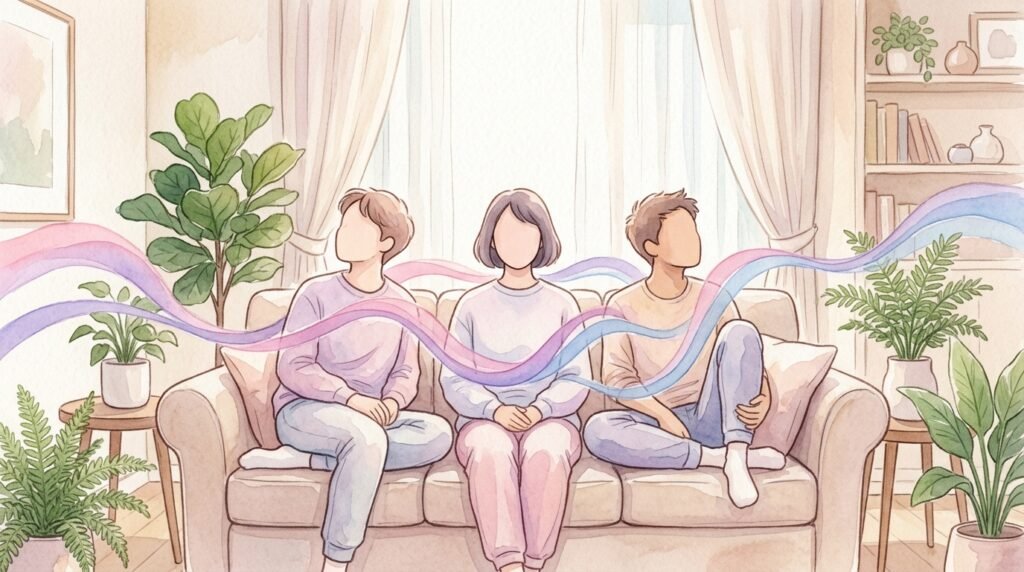
Bisexuality is not a “phase,” not “confusion,” and not “inability to decide.” It is one of the normal sexual orientations, yet there are still many myths, biphobia, and shame surrounding it. If you doubt yourself, hide your feelings, or have heard that “people like that don’t exist” — you are not alone, and this can be addressed.
In this article, I will explore what bisexuality truly is without stereotypes, which myths especially hurt, how external and internal biphobia operate, why doubt is not a sign of “inauthenticity,” and what steps can help you gradually accept your bisexual identity.
This text is suitable for you whether you already identify as bisexual, are just starting to consider the term, or are even afraid to think about it. My goal is to provide you with support, a language for describing your experience, and to show that your desire to be yourself is normal.
The article does not replace in-person therapy but can be the first step toward self-acceptance or a conversation with loved ones and a specialist.
Key Takeaways
- Bisexuality is a stable form of attraction not to “everyone” but to people of more than one gender. It is neither a phase nor confusion.
- Myths about bisexuality (“unreliable,” “promiscuous,” “not serious”) are manifestations of biphobia, not reality.
- Internal biphobia forms from external messages and can lead to shame, self-destructive relationships, and attempts to “fix” oneself.
- Doubts about bisexuality and the “questioning” period are a normal part of self-discovery and not evidence that you are “making it up.”
- You remain bisexual even if you are currently in a relationship with only one gender, married, or have never had sexual experiences.
- Self-acceptance relies on small steps: language to describe yourself, a supportive environment, gentle internal dialogues, and, if necessary, therapy.
- If you are struggling, feeling ashamed, or scared because of your orientation, it is important not to stay isolated and, if possible, reach out to an LGBTQ+ friendly specialist.
What Bisexuality Truly Is
In professional circles, there is no single “official” everyday definition, but definitions used by LGBTQ+ communities and organizations like BiNet and other activist groups play a significant role. Generally, bisexuality refers to emotional, romantic, and/or sexual attraction to more than one gender.
Importantly, this does not mean “a little bit of everyone” or “the same for all.” For different people, bisexuality manifests in very different ways:
- some feel stronger attraction to men, but also have feelings for women;
- some are primarily drawn to non-binary people but have experiences of feelings for men or women;
- some may have romantic attraction to one gender while having sexual attraction to several.
A broader term, “multigender” or “multipolar” orientation, is often used — this includes bi-, pansexuality and other identities that encompass attraction to more than one gender.
It is important to recognize: you choose the words to describe your experience. If “bisexual,” “bi+,” or “queer” resonate more with you — you have the right to use what feels like home.
Orientation as a Spectrum, Not Two Boxes
Many myths about bisexuality stem from an old model: as if there are only two orientations — hetero and homo, with a “gap,” “confusion,” or a temporary transition in between. The modern understanding of sexuality speaks of a spectrum.
Imagine a line where one pole represents attraction only to men, and the other — only to women. Between them lie many combinations, and outside this line exist attractions to non-binary people, absence of sexual attraction, and complex configurations of feelings.
| Model | How It Describes Orientation | What It Leads To |
|---|---|---|
| Black-and-white (Hetero/Homo) | Sees only two options, considers everything else “questionable” | Devalues bisexuality, increases shame and the sense of “inauthenticity” |
| Orientation Spectrum | Allows for many combinations of attraction and identities | Promotes self-acceptance and visibility of bisexual people |
People whose orientation does not fit neatly into strict categories often face pressure: “Just decide already.” But the reality is that not everyone finds one fixed place on this scale suitable — some remain flexible, and this does not make a person less real or deserving of respect.
A phrase you can tell yourself: “I don’t have to fit into someone else’s scheme for my experience to be real.”
Main Myths About Bisexuality
Biphobia often masquerades as “common sense” or “concern.” Here are some common myths that come up in therapy.
| Myth About Bisexuality | What Lies Behind It | How It Actually Is |
|---|---|---|
| “A bisexual is someone who hasn’t decided yet” | The demand to fit into a binary orientation system | Bisexuality is an independent, stable orientation |
| “Bisexuals cheat, they always want more” | The conflation of orientation with personal boundaries/values | Loyalty and honesty do not depend on orientation |
| “If you are in a heterosexual marriage, you are not bi” | Reducing orientation to current relationships | Orientation is about attraction in general, not just about a current partner |
| “Bisexuality doesn’t exist, it’s trendy” | Fear of what does not fit into the usual worldview | Bisexual people have existed throughout history; there’s just more visibility now |
Another painful myth is: “If you’re bi, then you’re automatically available for both men and women/non-binary people.” This devalues boundaries, consent, and a person’s right to choose whom to engage with.
- Being bisexual does not mean wanting everyone.
- Having attraction to multiple genders does not obligate you to have experiences with each of them.
- Bisexuality does not make you dangerous, unreliable, or “too sexual.”
If you catch yourself thinking, “There’s something wrong with me since I feel attracted to… and…,” try replacing it with: “My attraction is multifaceted. It doesn’t make me a bad person.”
Biphobia: External and Internal
Biphobia is the fear, contempt, or devaluation of bisexuality. It can originate from both the heterosexual majority and some parts of the LGBTQ+ community.
Biphobia often manifests in statements like:
- “You just want attention”;
- “You’re unsafe, you could leave for another gender at any moment”;
- “You’re just gay/lesbian but afraid to fully admit it”;
- “You’re heterosexual, just experimenting.”
When such phrases are repeated over years, they settle within as the voice of the inner critic.
| Type of Biphobia | How It Manifests Externally | What It May Sound Like Internally |
|---|---|---|
| External | Jokes, devaluation, refusal to acknowledge orientation, stereotypes in media | “I am probably really unreliable,” “Better not engage with me” |
| Internal | Self-criticism, shame, attempts to “fix” orientation, denial of feelings | “I need to finally choose,” “If I’m dating a man/woman, I have no right to call myself bi” |
Sometimes internal biphobia leads to risky or painful scenarios:
- entering heterosexual relationships “to be like everyone else,” ignoring other attractions;
- avoiding closeness altogether to “not accidentally out myself”;
- devaluing feelings toward people of the same gender or non-binary people as “not serious”;
- tormenting oneself with questions like, “What if I’m deceiving my partner?” simply because you have the potential attraction to more than their gender.
Noticing internal biphobia in yourself does not mean acknowledging yourself as “bad.” It means recognizing a wound that arose not through your fault, which can now be gently healed.
Doubts About Bisexuality: Is This Normal?
Many people come with questions like: “What if I’m not bisexual but just confused?” or “Can I call myself bi if I haven’t had experiences with women/men/non-binary people?” Often, this is rooted in the fear of being a “fraud” — as if you have “not suffered enough” or “not proven” your orientation.
Doubts about bisexuality can intensify if there are no visible bi people around you, or if you read stories that are completely different from yours. It’s important to remember:
- Orientation is not an exam that must be passed with facts from your personal life;
- Absence of experience does not negate attraction, fantasies, emotional pull;
- Identity can form and clarify over years; this is normal.
| Thought | What May Lie Behind It | Gentle Response to Yourself |
|---|---|---|
| “I’m not bi; I’ve never had same-sex relationships” | Reducing orientation to experience rather than attraction | “My feelings and fantasies are real, even if my real experience is limited for now” |
| “If I’m in doubt, then I’m not bi” | The desire for black-and-white clarity, anxiety | “The right to doubt belongs to every person. This does not nullify my orientation” |
Gently exploring your history can help. For example, it’s helpful to ask yourself questions like:
- How did I fall in love at different ages? Who exactly attracted me, and what was it that drew me in?
- What fantasies and notions of intimacy have I had for a long time?
- What moments in my life have I devalued as “too insignificant” even though they meant something?
If you want to delve deeper, you can read the piece on how to understand your sexual orientation — it has more exercises and questions for self-observation.
Bisexuality and Relationships: Confusing Labels
A common source of confusion is the idea that orientation changes based on the current partner. For example, a person identifies as bisexual but has been living in a heterosexual marriage for a long time. From the outside, they may be viewed as “hetero,” while internally, they may feel like a “traitor” to the LGBTQ+ community or, conversely, a “deceiver” to their partner.
- Your relationships do not nullify your bisexuality.
- Your partner is not “insufficient” if you can feel attraction to other genders.
- Monogamous, open, polyamorous, and other relationship formats can be chosen by people of any orientation.
It’s important to distinguish:
| What | What It Is About | Example |
|---|---|---|
| Sexual Orientation | Who your attraction is generally directed towards | “I might feel attracted to men and women” |
| Relationship Format | How you agree on closeness with specific people | “My partner and I chose monogamy/open relations” |
A gentle phrase in relationships might sound like this: “I am bi, but I chose to be in a relationship with you. It’s a conscious choice, not a backup option.”
Coming Out as Bisexual
Coming out can often be complicated for bisexual people. Society may not take it seriously (“but you’re with a man/woman, what’s the difference?”), and some in the LGBTQ+ community may suspect “privileges” or “indecision.”
However, coming out is not an obligation but your right. You can come out selectively, in a safe environment, and have different levels of openness in different areas of your life.
- First, it’s helpful to assess your safety: emotional, financial, and physical.
- You might start with more neutral people — friends, online communities, therapists.
- Coming out is a process, not one big scene. You can take it step by step.
Sometimes it’s essential to state: you are not obligated to “prove” your bisexuality with examples or details of your intimate life. Your statement, “This is how I feel,” is enough.
If you’re preparing for a conversation, it can be helpful to practice in advance: verbally or in writing, formulate what you want to say and what will support you in this discussion.
Parents, Friends, Society: Where It Hurts the Most
The words of important people hurt the most. For example:
- parents say: “It’s all because of the internet; it will pass”;
- friends joke: “It’s scary to get drunk with you; you look at everyone”;
- LGBTQ+ acquaintances say: “You’re just afraid to admit you’re gay/lesbian.”
Against this backdrop, the feeling that “being bi” means constantly justifying yourself can form. This is exhausting and can lead to burnout, depression, and anxiety.
- You have the right to limit communication with those who consistently devalue your identity.
- You have the right not to discuss your orientation if you feel it’s unsafe.
- You have the right to seek a “chosen family” — people and communities that accept you.
If you live in an environment with a lot of homo- and biphobia, the topic of self-acceptance becomes especially acute. In this case, support from a specialist and materials on how to maintain yourself when society rejects you may be useful. For example, you can read the article on self-acceptance when society rejects.
Self-Help and Self-Acceptance Practices
Self-acceptance is not a single conclusion of “I am bi and that’s it,” but a process. It usually includes several directions.
1. Language and Knowledge
- Read personal stories of bisexual people — they help you see that you are not alone.
- Learn the concepts: bisexuality, pansexuality, queer, etc. This broadens the space where you can find yourself.
- Track which words resonate with you and which provoke resistance or shame.
2. Internal Dialogue
Try to notice how you talk to yourself when thinking about your orientation. Often, the voices of biphobic parents, teachers, and media echo there.
- Write down 3-5 frequent accusatory thoughts about yourself.
- Next to each, try to formulate a warmer, supportive response.
- Think of this as practice: new formulations do not have to “feel real” the first time.
For example: “I am abnormal for liking both men and women” → “My attraction doesn’t make me abnormal. People are very different, and I have the right to be myself.”
3. Body and Safety
Shame and fear often “live” in the body: in tense shoulders, a tight stomach, a clenched jaw. Gentle body practices can help regain a sense of safety.
- Regularly notice what happens in your body when you think about your orientation.
- Practice gentle breathing, stretching, and taking short pauses throughout the day to “check in” with your body.
- Create small islands of safety: a favorite blanket, music, a candle — something that reminds you that you are safe “here and now.”
4. Environment
- Seek safe spaces: online communities, LGBTQ+ friendly specialists, friends with whom you can speak honestly.
- Limit toxic content: news, comments, jokes that trigger shame within you.
- Allow yourself to have different circles: you don’t have to have everyone around know about your orientation.
If you feel that figuring this out alone is difficult, you can seek support. In individual work, we explore your experiences, feelings, fears step by step and look for sustainable supports for you. You can learn more about the format on the self-acceptance therapy page.
Common Mistakes on the Path to Self-Acceptance
Making mistakes is a natural part of the journey. It’s important to notice them and gently correct your course.
- Trying to “prove” your orientation through experience. For example, entering relationships solely for validation to yourself and others. This often leads to pain and exhaustion.
- Completely denying one side of your attraction. “I’ll just stop thinking about my attraction to men/women/non-binary people” — usually, this does not work in the long run.
- Surrounding yourself only with toxic voices. Continuing to engage with people who regularly devalue or mock you for your bisexuality.
- Demanding instant clarity from yourself. “Today I must definitively decide who I am.” This increases anxiety and hinders natural exploration.
| Common Mistake | What It Leads to | How It Can Be Different |
|---|---|---|
| “Now I’ll tell everyone, and it will become easier” | Risk of a traumatic experience if the environment is unsafe | Assess risks, start with safe people, prepare support for yourself |
| “I must be liked by everyone and avoid conflict” | Self-devaluation, relinquishing boundaries | Learn to separate your right to exist from others’ approval |
If you notice that you have fallen back into an old scenario (for example, getting into relationships “to be like everyone else”), it’s important not to blame yourself but to ask: “What has this taught me, and how can I care for myself now?”
When to Seek Help from a Psychologist
Reaching out to a psychologist is not a sign of “weakness,” but a way to take care of yourself when your resources are at their limit. Consider seeking professional support if:
- Thoughts about your sexuality cause you constant anxiety or despair;
- You feel strong shame, self-disgust, or perceive your body as “alien”;
- Due to fear of disclosure, you avoid relationships, intimacy, and communication;
- There are thoughts of self-harm or suicide (in this case, it is important to seek help as soon as possible);
- You live in an unsafe, aggressive environment and need a supportive person nearby, even online.
In therapy, we will not “make you heterosexual” or “push you” toward any particular identity. My role as a specialist is to create a space where you can safely explore your experiences, learn to rely on yourself, and unload shame and anxiety.
If you resonate with this format and want to move toward more stable self-acceptance, you can learn more about self-acceptance therapy and, if desired, schedule a consultation.
How Therapy Helps Accept Your Bisexuality
Psycho-therapy is a process where you bring your stories, fears, and hopes, and the specialist helps unpack and make sense of them. In the context of bisexuality, this may look like:
- Exploring your history of attraction and relationships without the pressure to “decide” by a deadline;
- Breaking down myths and beliefs about bisexuality that you have absorbed from family, society, media;
- Working with internal biphobia, voices of shame and self-deprecation;
- Finding safe formats for coming out (if you wish);
- Strengthening boundaries — learning to say “no” to toxic statements and relationships;
- Offering support in building relationships where you can be yourself.
Usually, we move at your pace: some may not want to say the word “bisexuality” at first, while others come with a formulated identity but with a lot of pain. In both cases, the atmosphere of non-judgment and respect for your boundaries is important.
Any feelings you have in therapy are welcome: confusion, anger at society, envy of “brave” queer people, fatigue, fear. There is space for all of this.
Resources and Support for Bisexual People
The feeling of loneliness and “I am the only one like this” is one of the heaviest. To alleviate it, it’s helpful to lean on different sources of support.
- Online communities and support groups. Various social networks and messengers have Russian-speaking and international LGBTQ+ and bi communities. It’s essential to choose those where there is moderation and respect for boundaries.
- Educational resources. Organizations that publish materials about sexual orientation without pathologizing rhetoric. Pay attention to the tone: it should be respectful and non-judgmental.
- LGBTQ+ friendly psychologists. Specialists who openly affirm their supportive attitude towards LGBTQ+ and do not practice “conversion” approaches.
- Personal support rituals. Journaling, art practices, music that remind you: “Everything is okay with me.”
In related materials on this website, you can find articles on how to work with internalized homophobia and how to build self-acceptance in a hostile environment — these overlap with the experiences of bisexual people in many ways.
More on the Topic
Frequently Asked Questions
Can I consider myself bisexual if I’ve never had experiences with one of the genders?
Yes. Bisexuality is primarily about attraction, not a list of actual relationships. Lack of experience may be due to safety, circumstances, fear, but it does not negate your feelings.
What is the difference between bisexuality and pansexuality?
The boundaries between these terms largely depend on the individuals themselves. Bisexuality often refers to attraction to more than one gender (not necessarily just men and women), while pansexuality refers to attraction regardless of gender. However, there is no strict medical distinction; you are free to choose the term that resonates with you more.
Can bisexuality be just a phase before realizing I’m gay/lesbian or heterosexual?
Sometimes people in a phase of exploration identify as bi and then find another term for themselves — this is normal. But it does not follow that bisexuality is “just” a phase. For many, it is a stable and lifelong orientation.
If I’m in a heterosexual marriage, is it honest to tell my partner about my bisexuality?
Honesty can be frightening, but many couples find that such conversations bring more closeness and understanding. It is essential to speak carefully, emphasizing that your orientation does not mean you want to change the format of the relationship. It is beneficial if the conversation occurs in a safe and respectful atmosphere, with the support of a specialist if needed.
Am I obligated to come out as bi?
No. Coming out is your right, not an obligation. Who and when learns about your orientation is for you to decide, depending on safety, desire, and resources. Some people are open in some areas of life and do not disclose in others — that’s also a valid option.
Do I need to see a psychologist to “definitively identify” my orientation?
The role of the psychologist is not to issue you a “verdict,” but to help you explore your experience and feelings. Therapy can be helpful if you are troubled by doubts, shame, or anxiety, but the decision about how you name yourself remains yours.
Does bisexuality necessarily imply equal attraction to different genders?
No. Many bisexual people have preferences: some are more attracted to one gender, others to another. This does not make them any less “real” bi. Bisexuality is about the presence of attraction to more than one gender, not strict equality.
Can I be bisexual and a monogamous person?
Yes. Monogamy or polyamory is about relationship formats, while bisexuality is about the direction of attraction. Bisexual people can establish monogamous, reliable, and long-term relationships just as people of any other orientation can.
How do I distinguish internal biphobia from real doubts?
Internal biphobia usually sounds harsh, accusatory (“there’s something wrong with me,” “I’m disgusting”). A lively exploration of self is more curious, sometimes anxious, but does not belittle you. If you’re unsure, it may help to have a conversation with a supportive specialist or someone from a safe community.
What should I do if my loved ones react negatively to my coming out?
First and foremost — take care of your safety and find a supportive space (other loved ones, communities, therapy). Reactions from loved ones are often tied to their fears and stereotypes, not your “wrongness.” Over time, some individuals may change their attitude, but your worth does not depend on that.
Sources and Helpful Materials
In preparing this material, I relied on contemporary understandings of sexual orientation and approaches to working with LGBTQ+ clients, including recommendations from major professional organizations.
- World Health Organization (WHO) — position on the diversity of sexual orientation and the inadmissibility of its pathologization.
- American Psychological Association (APA) — sections on sexual orientation, minority stress, and LGBTQ-affirmative therapy.
- International Classification of Diseases (ICD-11) — contemporary approach to issues of sexual orientation.
- National Institute of Mental Health (NIMH) — materials on the impact of discrimination and stigma on mental health.
- LGBTQ+ organizations’ resources addressing bisexuality and biphobia (international and local initiatives).
This material is intended for general informational purposes and does not substitute for personal consultation with a psychologist. If your condition is severe or poses a risk to yourself, it’s important to seek help from a specialist.