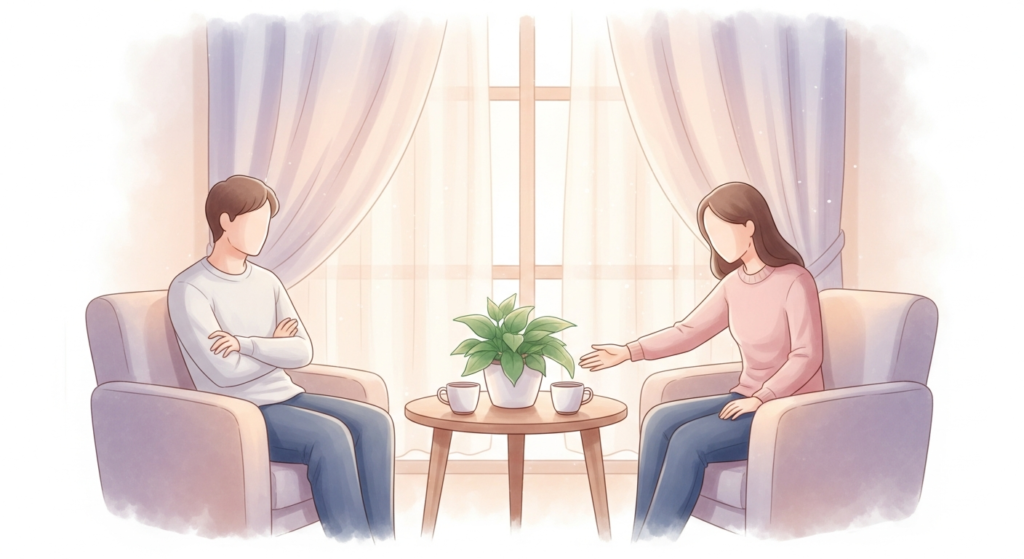
Jealousy may seem like proof of love, but often it destroys trust and intimacy. If you are looking for how to cope with jealousy and stop tormenting both yourself and your partner—you are already taking an important step towards healthier relationships.
Jealousy can be especially painful in same-sex relationships: there’s so much external pressure, judgment, uncertainty, and within there is also the fear of losing each other. It’s easy to start blaming yourself for “too strong emotions” or your partner for “provocations.” In reality, jealousy is a signal that can be worked on carefully.
In this article, we will explore how the mechanism of jealousy works, how it differs from pathological jealousy, how it relates to self-esteem and trust, and what steps can be taken to change our reactions. I draw from my experience working with LGBTQ+ individuals and same-sex couples: your experiences, identity, and context will be respected here.
This article does not promise “magical techniques in 5 minutes,” but you will receive a map: what is happening to you, why it hurts so much, and what real steps are possible—individually and as a couple.
Main points in brief
- Jealousy is not a “pathology” per se, but a signal of the fear of losing important relationships or one’s value in the eyes of a partner.
- The strength of jealousy is often related not to the partner’s behavior, but to past experiences, self-esteem, and basic trust in people.
- “Fighting” jealousy through control, checks, and prohibitions almost always increases tension and distances partners from each other.
- Healthy work with jealousy involves exploring one’s triggers, learning to self-soothe, and establishing clear agreements in the couple.
- In same-sex relationships, jealousy is exacerbated by invisibility, fear of coming out, internal homophobia, and competition within small communities.
- Pathological jealousy manifests as obsessive suspicions, surveillance, threats; this is a reason to seek professional help and ensure safety.
- Individual and couple therapy help restructure habitual scenarios, strengthen trust, and restore the sense of relationships as a place of support rather than constant threat.
What is jealousy in psychological terms
Jealousy is a complex emotion that intertwines fear, anger, pain, shame, and resentment. At its deepest level, it is a reaction to the threat of loss: of a person, their attention, or unique place in their life.
Importantly, jealousy is not the same as envy. Envy is “I want what someone else has.” Jealousy is “I fear that I will lose what I have.”
Most often, jealousy includes several levels:
- Emotional: anxiety, anger, resentment, the feeling of “I am being betrayed” or “I am not chosen.”
- Physical: tightness in the chest or stomach, rapid heartbeat, heat, tension.
- Cognitive (thoughts): “they are definitely cheating on me,” “I am not good enough,” “everyone lies.”
- Behavioral: checks, interrogation, scenes, withdrawal, passive aggression.
When we talk about how to cope with jealousy, it’s important to consider all these levels. It’s impossible to simply “turn off thoughts” or “not feel” — but you can change your attitude towards your reactions and choose different actions.
You can tell yourself: “Feeling jealous does not make me a bad person. It’s a signal that I can work with step by step.”
Why we get jealous: internal and external reasons
Jealousy never arises “out of nowhere.” Its causes can be conditionally divided into external and internal, although in reality they intertwine.
| Factor | How it manifests | What it can teach |
|---|---|---|
| Personal experience of betrayal, deceit | Distrust even in neutral situations | The importance of working through trauma rather than controlling the current partner |
| Low self-esteem | Thoughts like “I am easily replaceable,” “I am worse than others” | It’s necessary to strengthen self-worth, not restrict the partner’s freedom |
| Traumatic childhood experience | Intense fear of abandonment, clinginess or, on the contrary, detachment | Working on attachment, trusting relationships with others |
Internal reasons can include:
- beliefs like “if you love me, you don’t look at anyone else;”
- shame and rejection of one’s sexuality or gender identity;
- fear of loneliness and the belief that “without a partner I am nobody;”
- experience of emotional instability in the family;
- unprocessed traumas from previous relationships.
External factors:
- actual violations of agreements in the couple (flirting, cheating, hiding important facts);
- unclear boundaries of communication with exes, friends, colleagues;
- absence of open conversations about relationship formats (monogamy, openness, etc.);
- social pressure, gossip within the LGBTQ+ community;
- secrecy in relationships due to fear of coming out (when a partner, in essence, “lives a double life”).
Understanding your reasons is the first step to stop seeing jealousy as “madness” and start treating it as a understandable, though painful, reaction.
Jealousy in same-sex relationships: a special context
In same-sex relationships, jealousy is often exacerbated by factors specific to LGBTQ+ people:
- Invisibility and secrecy. If a partner is not ready to come out, the relationship has to be hidden. This can create a sense that they “have another life” where you are not included.
- Internal homophobia. If a part of you still feels ashamed of your orientation, any threat to the relationship is perceived particularly acutely: “this is the only place where I can be myself.”
- Small community. In LGBTQ+ circles, it often seems “everyone knows everyone,” past and potential partners overlap. This creates many reasons for anxiety and comparison.
- Experience of bullying and rejection. If you have been rejected due to your orientation/gender, the fear of being “thrown out again” naturally intensifies jealousy.
Sometimes jealousy becomes a way to test: “Am I important enough that they would go against society, family, religious norms for me?” This is a very heavy burden for relationships.
It can be helpful to gently acknowledge: “Yes, our context is complicated. My jealousy is partly about this world, not just about my partner.”
Healthy and pathological jealousy: how to distinguish
There are different types of jealousy. It’s important to distinguish “living” feelings that can be worked on in a couple from states that threaten safety.
| Type of jealousy | Signs | What can help |
|---|---|---|
| Living (moderate) | Unpleasant feelings may arise sometimes, but you can talk about them without degrading your partner | Open dialogue, setting boundaries, working on self-esteem |
| Intensified | Constant suspicions, checks, strong mood swings | Individual therapy, sometimes couple therapy, exploring your triggers |
| Pathological | Obsessive ideas of infidelity without basis, surveillance, threats, violence | Seeking help from specialists, assessing safety, possibly involving loved ones or support services |
Pathological jealousy may be related to various mental states and requires professional assessment. In this article, we discuss those cases when a person understands that jealousy is present and it is interfering, but still maintains at least partial control over their behavior.
Jealousy and self-esteem: how they are connected
One common illusion is: “If my partner behaved correctly, I wouldn’t be jealous.” In practice, the strength of jealousy is much more related to how you see yourself.
When self-esteem is based on external validation (“I am okay only if I am loved, chosen, not criticized”), any hint of a partner’s interest in someone else is perceived as a threat to your existence. Hence—emotional swings, scenes, dramatization.
With stable self-esteem, a person is more likely to think: “I feel uncomfortable, I am angry and worried. I want to understand what’s happening and protect myself, but I won’t disappear even if the relationship doesn’t last.”
It’s helpful to trace your automatic thoughts during jealousy:
- “I am worse than…”
- “I won’t be chosen if someone else appears”
- “It always happens to me”
- “No one can truly love me”
These are not facts, but old scripts that are activated now. This is what makes sense to work on if you want to not just “stop being jealous,” but learn to be more supportive of yourself.
Jealousy and trust: when fear interferes with intimacy
Trust is not the absence of doubts. It’s a choice: “I rely on the facts, on the experience of the relationship, and on my ability to cope if something goes wrong.”
Jealousy and trust do not exclude each other. You can simultaneously:
- feel pain and anxiety,
- talk about them with your partner,
- and at the same time not turn the other person into a “defendant.”
When fear completely replaces trust, typical scenarios occur:
| Scenario | What it looks like | What it leads to |
|---|---|---|
| Total control | Checking messages, surveillance, online checks, banning meetings | Increased tension, secrecy, sometimes actual infidelity |
| Avoidant position | “I won’t ask anything, but I still believe the worst” | Quiet withdrawal, resentment, emotional rupture |
| Pendulum | Sometimes scenes and accusations, sometimes requests “forgive me, I understand everything” | Unstable, exhausting relationship, loss of a sense of safety for both |
It is worth working not only with jealousy as an emotion, but also with understanding what trust means to you, what it can be based on now.
Common mistakes in dealing with jealousy
Attempts to “fight” jealousy often amplify suffering. Here are some common traps.
- Demanding that your partner “fix” your feelings. “Prove that you love me,” “make it so that I don’t feel jealous” — this is an unrealistic task for another person.
- Comparing yourself to imagined rivals. You will always lose to your fantasies: they present the other person as perfect.
- Using jealousy as a way to control. “If you really love me, you wouldn’t go out without me/check your phone/message someone else.”
- Shaming yourself for feeling jealous. Then you find yourself alone with both pain and shame, making it even harder to ask for support.
- Checking to “feel better.” Looking at messages, counting likes, sniffing clothes, etc., provides relief for a couple of minutes and reinforces the dependence on checking.
Internal support arises not from control, but from being able to care for yourself even when it’s scary and painful.
How to cope with jealousy: self-help steps
There are several directions you can move in by yourself. They do not negate the value of therapy, but often noticeably ease the state.
1. Notice triggers and name your feelings
Try for several days or weeks to note the situations that particularly heighten your jealousy:
- when your partner responds to someone in a messenger;
- when you see them in the company of certain people;
- when they are late or don’t respond immediately;
- when the conversation turns to exes or sexual experiences.
Write down what you feel and think in those moments. This will help you see recurring patterns.
2. Breathe and slow down before acting
Jealousy often activates “emergency mode”: the urge to immediately do something—text, call, create a scene, or end the relationship. A useful skill is to at least slightly increase the pause between feeling and action.
- Take a few slow breaths, noticing the support of your body (feet, back).
- Tell yourself: “I feel really bad right now, but I don’t need to resolve everything this minute.”
- Write down your thoughts in notes or a journal instead of immediately messaging your partner.
A phrase for yourself: “I can take care of myself first, and then decide how to talk to my partner.”
3. Separate facts from fantasies
One of the key exercises in working with jealousy:
- What do I know for sure (facts)?
- What am I imagining?
- What other possible explanations exist?
For example: “My partner is online late at night”—that’s a fact. “They are definitely communicating with someone and want to cheat on me”—is already an interpretation. There may be other explanations: they are working, engrossed in a video, messaging a friend, or can’t sleep.
4. Support self-esteem outside of relationships
The more your self-worth relies on different areas (work, creativity, friends, hobbies, activism), the less a romantic connection alone defines “who you are.”
- Recall what brought you joy and a sense of competence before these relationships.
- Consider where you could seek support besides your partner (friends, community, therapy).
- Allow yourself small steps towards what is personally important to you.
This is not about “keeping backups” or “being autonomous to the point of coldness,” but about ensuring that your life is not reduced to one person.
How to talk about jealousy with your partner
One of the most important skills is learning to discuss jealousy not through accusations, but through openness and vulnerability. This is not easy, but it is possible.
Here are some guidelines:
- Speak about your feelings, not about “what they are like” (“I feel anxious and hurt,” rather than “you flirt with everyone”).
- Use “I-statements”: “I notice that…,” “I feel upset when…”.
- Choose a time when both of you are relatively calm, rather than in the heat of conflict.
- Formulate requests, not ultimatums.
Example: “When you are messaging your ex late at night, I start feeling very jealous. I need to feel safe in our relationship. Let’s try to figure out how to deal with this together.”
If talking without sliding into mutual accusations is not possible, this often signals that the couple may benefit from the support of a neutral third person—a psychologist. In LGBTQ+ friendly couple therapy, you can safely explore what lies behind jealousy and how you want to build your agreements. I describe the format in more detail on the page therapy for same-sex couples.
Boundaries and agreements that reduce jealousy
Jealousy diminishes where boundaries and expectations are clearer. Each couple has their own boundaries; there are no ready-made templates. But there are areas that are certainly useful to talk about.
| Topic | Questions for discussion | Possible agreements |
|---|---|---|
| Communication with exes | What format of contact is comfortable? Is it necessary to inform about meetings? | “We don’t hide meetings,” “we don’t discuss intimate details of our current relationships,” etc. |
| Flirting and friendship | Where does each person draw the line between friendship and flirting? | For example: don’t discuss sexual topics with those you’re attracted to. |
| Relationship format | Are we monogamous? Open? Ethically non-monogamous? | Clearly articulated rules about what constitutes cheating in your couple. |
Importantly: agreements are alive and can be reviewed. But a one-time honest conversation usually significantly reduces anxiety, including pathological jealousy, if it hasn’t already gone too far.
When jealousy becomes dangerous
Sometimes jealousy shifts from being a “how to stop being jealous” topic to a question of safety.
- You are threatened regularly (“if you leave/if you communicate like this — I…”).
- Your partner controls messages, location, finances.
- There is physical or sexual violence, “raising” through fear.
- Your partner cuts you off from friends, family, community, motivated by jealousy.
- You notice yourself having aggressive outbursts that scare you.
In such situations, the priority is safety: your own and your partner’s. Sometimes this means temporarily increasing distance, involving friends, crisis services, resources of LGBTQ+ support organizations. If you feel you might harm yourself or another, it’s important not to stay alone with this and to seek professional help as soon as possible.
When to seek help from a psychologist and how therapy works
Support from a specialist is especially helpful if:
- you notice that jealousy arises in all or almost all relationships;
- logically you understand that there is little basis for suspicions, but you can’t stop;
- you have already tried to “come to terms with yourself,” but keep returning to checks and scenes;
- jealousy is associated with a heavy experience (violence, betrayal, bullying);
- against the background of jealousy, anxiety, burnout, depressive symptoms are growing.
In therapy, we usually work in several directions:
- we analyze specific episodes of jealousy and find what exactly triggers them;
- we explore your relationship history, family experience, childhood experiences of attachment;
- we learn to notice and stop self-supporting jealous thoughts;
- we develop self-regulation skills (how to soothe yourself without destructive actions);
- we gradually strengthen self-esteem and internal support.
In couple therapy (especially relevant for same-sex couples), we also work on communication and agreements, finding common rules that consider both partners. Sometimes, it’s about learning to say: “It hurts me so much when…,” without turning it into an accusation.
If you feel that jealousy is already interfering with your life and building intimacy, you can read more about the format of therapy for same-sex couples and, when you are ready, seek support. Our goal in therapy is not to “remove” feelings, but to ensure that they stop controlling your life.
If your partner is jealous: how to support and not lose yourself
Being on the other side of jealousy is also very difficult. It’s important to maintain compassion for your partner while not agreeing to destructive forms of control.
- Acknowledge their feelings, if you are able: “I can see that you are scared/hurt.”
- Don’t endlessly justify yourself if you have already answered the questions thoughtfully.
- Talk about your boundaries: what is acceptable for you and what isn’t.
- Suggest finding solutions together (“maybe we can talk to a psychologist?”) rather than taking on all the responsibility.
- Don’t stay in a situation of violence to “prove your loyalty.”
A phrase that can help frame the conversation: “I am willing to discuss your feelings and find out how we can both feel more at ease. But I am not willing to live under constant control and fear.”
A brief plan of practices for each day
In order for new ways of dealing with jealousy to become a habit, it’s important not just to understand, but also to practice a bit.
| Step | What to do | Why it’s necessary |
|---|---|---|
| 1. Track triggers | Briefly write down situations when you feel jealousy particularly strongly | To understand your patterns instead of feeling “this always happens suddenly” |
| 2. Pause and breathe | Before taking any action, take several slow breaths | To reduce impulsiveness and give yourself a chance to choose different behavior |
| 3. Separate facts and thoughts | Ask yourself questions: “What do I know for sure? What am I imagining?” | To weaken the power of catastrophic scenarios |
| 4. Small steps for yourself | Take at least one action a day for yourself, not for the relationship | To strengthen your sense of self-worth and separateness |
If you start with at least these steps, jealousy will probably not disappear instantly, but you will have more space for choice rather than just automatic reactions.
More on the topic
Frequently asked questions
Can jealousy be completely eliminated?
Jealousy is a natural human emotion, like fear or sadness. It is usually impossible and unnecessary to completely “turn it off.” A realistic goal is to make jealousy less destructive: understand its causes, notice early signs, not let it run wild, and choose more gentle actions.
Does my jealousy mean the relationship is “not right” and I need to break up?
Not necessarily. Strong jealousy often reflects your internal experiences: past traumas, fears of abandonment, vulnerable self-esteem. Sometimes relationships are indeed unsafe, and it’s important to honestly acknowledge this too. However, not every instance of jealousy is a sign that the connection must be ended immediately; more often it invites you to examine what is happening within you and between you.
How to tell if it’s jealousy or if there’s really something wrong with the partner’s behavior?
It’s helpful to look at the facts and agreements. Is your partner violating what you have clearly agreed upon? Is there secrecy, regular lying? If the facts are present, the conversation should not only address jealousy but also boundaries and respect. If there are few facts but a lot of anxiety, the focus shifts to working on your feelings and the request for more clarity in the relationship.
Do checking phones and social media help cope with jealousy?
Usually not. Checks provide temporary relief but reinforce the habit of seeking confirmation of one’s fears. Over time, you start feeling calmer only after the next check, while trust and respect in the couple decline. It is far more beneficial to talk about your experiences and seek shared agreements.
What to do if my partner says I am “too jealous?”
You can take this as feedback and an invitation to talk. Try to ask what specific actions of yours are perceived as excessive. Share what feelings lie behind them, and together explore what forms of support and boundaries would be more eco-friendly for both of you. If the conversation quickly descends into accusations on both sides, this might be a reason to consider couple therapy.
Is it normal to be jealous of past partners?
Yes, being jealous of the past is a common experience. Often, this is driven by fears of comparison and feelings of one’s own “insufficiency.” It helps to talk openly about your feelings, negotiate how detailed you are willing to discuss past relationships, and work on your self-worth without trying to “erase” your partner’s history.
How to help a partner who is very jealous of me?
You can listen, acknowledge their feelings, and be more transparent in areas where you are comfortable. However, your task is not to “cure” your partner’s jealousy. It’s important to clearly set your boundaries and gently suggest seeking help from a psychologist if necessary. If jealousy leads to control or violence, your safety is the priority.
How long does it take to work on jealousy in therapy?
The timelines are individual and depend on the depth of the causes, readiness to change, and the presence of accompanying difficulties (trauma, anxiety, or depressive conditions). Sometimes the first changes in perception and behavior are noticeable within a few weeks, but establishing stable new patterns usually takes months. It’s important to go at your own pace and not expect instant miracles.
Will couples therapy help if I am primarily the one feeling jealous?
Often—yes. Even if the main pain and jealousy are on your side, the partner is also included in the dynamic: their reactions can intensify or lessen the tension. In couple therapy, both can learn to speak about difficult feelings, build agreements, and supportive forms of behavior. Sometimes this is combined with individual work for each person.
What to do if jealousy is accompanied by self-deprecation and self-destructive thoughts?
This is an important signal that you are severely overwhelmed and need support. Try not to remain alone with such thoughts: talk to someone you trust, and if possible, seek help from a psychologist or psychiatrist. If the thoughts become obsessive or frightening, it’s important to seek professional help as quickly as possible.
Sources and useful materials
World Health Organization (WHO) — general approaches to understanding mental health and well-being.
American Psychological Association (APA) — materials on attachment, trust, and relationship dynamics.
International Classification of Diseases ICD-11 — official criteria for mental disorders related to affective sphere and behavior.
National Institute of Mental Health (NIMH) — information on anxiety, depression, and other conditions that can amplify jealousy.
Materials from LGBTQ+ support organizations, which discuss the specifics of same-sex relationships, coming out, and the impact of stigma on mental health, are also useful.
This material is for general informational purposes and does not substitute for personal consultation with a psychologist. If the state is serious or there is a risk to oneself, it is important to seek professional help.
{“@context”:”https://schema.org”,”@type”:”FAQPage”,”mainEntity”:[{“@type”:”Question”,”name”:”Can jealousy be completely eliminated?”,”acceptedAnswer”:{“@type”:”Answer”,”text”:”Jealousy is a natural human emotion, like fear or sadness. It is usually impossible and unnecessary to completely “turn it off.” A realistic goal is to make jealousy less destructive: understand its causes, notice early signs, not let it run wild, and choose more gentle actions.”}},{“@type”:”Question”,”name”:”Does my jealousy mean the relationship is “not right” and I need to break up?”,”acceptedAnswer”:{“@type”:”Answer”,”text”:”Not necessarily. Strong jealousy often reflects your internal experiences: past traumas, fears of abandonment, vulnerable self-esteem. Sometimes relationships are indeed unsafe, and it’s important to honestly acknowledge this too. However, not every instance of jealousy is a sign that the connection must be ended immediately; more often it invites you to examine what is happening within you and between you.”}},{“@type”:”Question”,”name”:”How to tell if it’s jealousy or if there’s really something wrong with the partner’s behavior?”,”acceptedAnswer”:{“@type”:”Answer”,”text”:”It’s helpful to look at the facts and agreements. Is your partner violating what you have clearly agreed upon? Is there secrecy, regular lying? If the facts are present, the conversation should not only address jealousy but also boundaries and respect. If there are few facts but a lot of anxiety, the focus shifts to working on your feelings and the request for more clarity in the relationship.”}},{“@type”:”Question”,”name”:”Do checking phones and social media help cope with jealousy?”,”acceptedAnswer”:{“@type”:”Answer”,”text”:”Usually not. Checks provide temporary relief but reinforce the habit of seeking confirmation of one’s fears. Over time, you start feeling calmer only after the next check, while trust and respect in the couple decline. It is far more beneficial to talk about your experiences and seek shared agreements.”}},{“@type”:”Question”,”name”:”What to do if my partner says I am “too jealous?””,”acceptedAnswer”:{“@type”:”Answer”,”text”:”You can take this as feedback and an invitation to talk. Try to ask what specific actions of yours are perceived as excessive. Share what feelings lie behind them, and together explore what forms of support and boundaries would be more eco-friendly for both of you. If the conversation quickly descends into accusations on both sides, this might be a reason to consider couple therapy.”}},{“@type”:”Question”,”name”:”Is it normal to be jealous of past partners?”,”acceptedAnswer”:{“@type”:”Answer”,”text”:”Yes, being jealous of the past is a common experience. Often, this is driven by fears of comparison and feelings of one’s own “insufficiency.” It helps to talk openly about your feelings, negotiate how detailed you are willing to discuss past relationships, and work on your self-worth without trying to “erase” your partner’s history.”}},{“@type”:”Question”,”name”:”How to help a partner who is very jealous of me?”,”acceptedAnswer”:{“@type”:”Answer”,”text”:”You can listen, acknowledge their feelings, and be more transparent in areas where you are comfortable. However, your task is not to “cure” your partner’s jealousy. It’s important to clearly set your boundaries and gently suggest seeking help from a psychologist if necessary. If jealousy leads to control or violence, your safety is the priority.”}},{“@type”:”Question”,”name”:”How long does it take to work on jealousy in therapy?”,”acceptedAnswer”:{“@type”:”Answer”,”text”:”The timelines are individual and depend on the depth of the causes, readiness to change, and the presence of accompanying difficulties (trauma, anxiety, or depressive conditions). Sometimes the first changes in perception and behavior are noticeable within a few weeks, but establishing stable new patterns usually takes months. It’s important to go at your own pace and not expect instant miracles.”}},{“@type”:”Question”,”name”:”Will couples therapy help if I am primarily the one feeling jealous?”,”acceptedAnswer”:{“@type”:”Answer”,”text”:”Often—yes. Even if the main pain and jealousy are on your side, the partner is also included in the dynamic: their reactions can intensify or lessen the tension. In couple therapy, both can learn to speak about difficult feelings, build agreements, and supportive forms of behavior. Sometimes this is combined with individual work for each person.”}},{“@type”:”Question”,”name”:”What to do if jealousy is accompanied by self-deprecation and self-destructive thoughts?”,”acceptedAnswer”:{“@type”:”Answer”,”text”:”This is an important signal that you are severely overwhelmed and need support. Try not to remain alone with such thoughts: talk to someone you trust, and if possible, seek help from a psychologist or psychiatrist. If the thoughts become obsessive or frightening, it’s important to seek professional help as quickly as possible.”}}]}