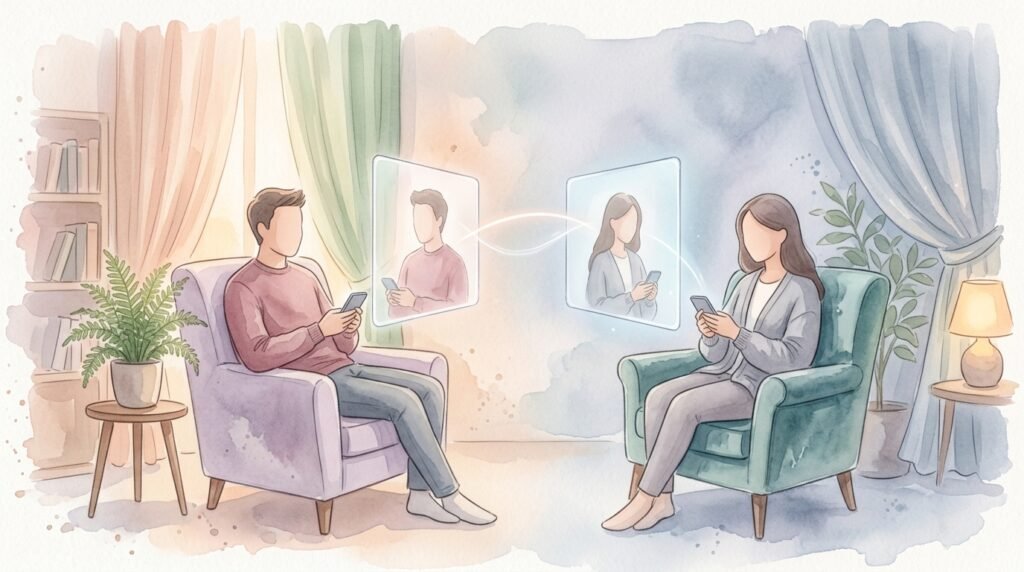
Long-distance relationships can seem like a test of endurance: different cities or countries, time zone differences, infrequent meetings. This is especially familiar to same-sex partners, who often face judgment or secrecy even without the distance. In this article, we will discuss how to maintain closeness when long-distance relationships have become part of your reality.
If you are experiencing separation in a couple, constantly thinking about how to maintain a long-distance relationship and not lose trust, this topic is for you. We will look at what rituals help you feel connected, how to distinguish care from control, what is important to agree upon, and when it makes sense to involve a psychologist.
You are not obligated to “heroically endure” and pretend that everything is easy for you. Long-distance relationships are a distinct format that requires honest conversations, support, and tenderness for yourself and your partner. Meetings, daily life, and communication can be structured in various ways—it is important that this is done in a way that is eco-friendly for your couple.
This material will be useful for those who are just preparing for separation (for example, due to studies, migration, or a job change), as well as for those who have been living with intimacy at a distance for a long time and want less anxiety and more stability.
Main Points Briefly
- Long-distance relationships are not “worse” or “weaker,” they are just a different format that requires more awareness and clear agreements.
- The key resource for a couple at a distance is trust, not total control. Suspicions often amplify distance instead of reducing it.
- Rituals of closeness (morning messages, evening calls, shared “online activities”) help the nervous system feel stability and support.
- It is important to discuss expectations: frequency of communication, topics of fidelity, meetings, daily life, financial matters, and future plans.
- Jealousy and anxiety in separation are normal, but they can be managed—through conversations, support, and working with one’s own fears.
- Same-sex couples often struggle more due to external unsafety, secrecy, or lack of family support. This is not “your fault,” but part of the context.
- If the distance turns life into constant pain, frequent conflicts arise, and you feel at a dead end—this is a reason to seek help, including couples therapy.
Why Long-Distance Relationships Can Be Challenging
Separation in a couple almost always stirs up many feelings: from inspiration and romance to anger, loneliness, and helplessness. For the psyche, a partner is not just a person, but also an important element of safety: a familiar scent, hugs, a voice, shared daily life.
When distance appears, physical contact and familiar routines disappear or change significantly. The nervous system has to seek stability anew, which can manifest in the following ways:
- heightened anxiety and jealousy;
- a feeling of “I no longer feel that we are together”;
- irritation over trivial matters;
- a desire to control everything—calls, social media, location;
- one partner feels like they are “giving more”;
- a fear that the other will “gradually get used to being apart.”
To this is added the external environment: migration, new job, studies, different culture. Especially if you are LGBTQ+ and have to be more cautious. In such cases, a partner at a distance becomes an even more unique “island of normality,” and the pressure on the relationship increases.
It is important: strong emotions in such situations are not a sign of your weakness and do not prove that something is “wrong” with the relationship. This is a natural reaction to the loss of familiar closeness.
| What Has Changed | How It Might Feel | What Can Support |
|---|---|---|
| No familiar touches, hugs | Feeling empty, “as if my partner is gone” | Online closeness rituals, discussions about feelings, self-care |
| Differences in schedules and time zones | Frequent misunderstandings, feeling “you’re not making time” | Clear agreements on communication times, flexibility and respect for each other’s schedules |
| A lot of uncertainty about the future | Anxiety, fear of losing contact, difficulty with planning | Discussing common goals, realistic meeting plans |
Trust at a Distance vs Control
When a partner is far away, there is a fear of losing connection. This gives rise to the desire to know everything: who is around, who they are spending time with, why they didn’t respond for 20 minutes. It seems that if there is more control, it will feel calmer.
In practice, it works the other way around: the more rigid the control, the more tension there is both between you and within each of you. Trust at a distance is not “blind faith” or ignoring one’s intuitive signals. It is the result of several elements:
- experience that you both keep your agreements;
- openness in conversations about fears and jealousy;
- respect for each other’s personal boundaries;
- willingness to acknowledge mistakes and apologize.
| Control | Trust | What Can Help Transition from Control to Trust |
|---|---|---|
| “Send me a screenshot of who you’re with,” checking phones, demands to always be available | “I care about knowing how you are. Let’s agree on a specific time we’ll definitely connect” | Discuss your fears, acknowledge vulnerability, find a balance between awareness and control |
| Secretly checking messages | Direct request: “I’m feeling insecure, can we talk about how you interact with others?” | Learn to talk about jealousy without blame, agree on transparency within comfortable limits for both |
A phrase that can support instead of control: “I’m really worried right now and afraid that something is changing between us. Can we talk about this?”
If the topic of jealousy and control is already felt painfully, it may be helpful to work separately with a psychologist or discuss it during a couples session.
Expectations and Agreements: Where to Start
One of the most common reasons for conflicts in long-distance relationships is not that partners want different things, but that they haven’t discussed what exactly they expect from each other.
It is helpful to at least discuss the following:
- Frequency and format of communication. Every day? Several times a week? Text, audio, video?
- Communication times. When you definitely do not write (sleep, work) and when communication is a priority.
- Topic of fidelity. What does betrayal mean for each of you? Are there agreements on the openness/closedness of the relationship?
- Meetings. How often do you plan to see each other? Who travels more often?
- Money. Who and how pays for trips, communication, shared plans?
- Horizons for the future. Is this a temporary separation or a long one? Is there a guideline “when we can live together”?
| Topic | What to Ask Yourself | Example Phrase to Your Partner |
|---|---|---|
| Communication | How much contact do I need to feel connected and avoid burnout? | “It’s important for me to hear you every day for at least 10–15 minutes. How does that feel for you?” |
| Fidelity | What is absolutely unacceptable for me? Where is the line between flirting and betrayal? | “I need to understand how you see fidelity now that we are far apart.” |
| Future | How important is it for me to have a plan with dates and goals? | “I feel more at ease when there is at least a rough guideline for when we can live together. Let’s discuss the options.” |
If you are afraid of “scaring” your partner with discussions about the future, you can say: “I’m scared to bring up this topic because I fear I’ll seem pushy, but it’s important for me to understand our guidelines.”
Rituals of Closeness at a Distance
Rituals are recurring small actions that create a sense of stability and “us” as a couple, even if you are far apart. They serve as a kind of “glue” for long-distance relationships.
Examples of rituals of closeness:
- a morning or evening message “how did you wake up/sleep?”;
- a daily voice message for 2–3 minutes sharing about your day;
- weekly “online dinners” via video call;
- watching the same series with discussions;
- playing games together, reading a book, going for a walk via video call;
- a “care package”—sending each other gifts, letters, postcards.
| Type of Ritual | Example | What It Provides |
|---|---|---|
| Daily Short Contact | Message “morning/night” or photo “snippet of the day” | A sense that you are “involved” in each other’s lives, reduced anxiety |
| Weekly “Date” | Online dinner, board game, movie together | Nourishes romance, creates shared memories |
| Long-Term Projects | Shared playlist, photo album, list of places “we will go together” | Focus on the future, sense of shared journey |
It is important that the rituals be alive and supportive, rather than turning into a rigid demand “if you didn’t call by 9 PM, it means you don’t love me.”
- Discuss what rituals truly bring joy and which ones have become a burden.
- Periodically re-evaluate the format, especially if schedules or circumstances change.
- Allow each other the right to sometimes not be in the resource and change plans.
How to Talk When There Are No Hugs: Communication and Emotions
In long-distance relationships, words and tones take on part of the function of hugs, kisses, and touches. This leads to a greater risk of misunderstanding: a message without an emoji may seem cold, a delay in response may be a sign of detachment.
What can support your communication:
- Speak significant thoughts aloud. Don’t assume your partner “gets it.”
- Use “I-statements.” “I feel…,” “It’s important for me…” instead of “You always…,” “You never…”.
- Notice the context. Important topics should not be discussed between meetings and not at night when you are both drained.
- Set your boundaries. “I’m too tired right now; let’s continue tomorrow.”
A formula that often helps: “When A happens, I feel B, I would like C.”
For example: “When you disappear for the whole day without warning, I feel anxiety and loneliness. A short message that you have a busy day would help me.”
If it’s difficult to talk about feelings, it may be helpful to read an article on how to talk about feelings with a partner.
Jealousy and Anxiety in Separation
Jealousy in long-distance relationships almost always intensifies: you can’t see how your partner is living, who they are interacting with, how they spend their evenings. Imagination fills in the worst scenarios, especially if there has been past experience of infidelity or devaluation.
It is important to separate several levels:
- Real facts. Specific actions that contradict agreements.
- Your own fears. “I’m afraid of being left,” “I don’t feel worthy.”
- Social context. If you have previously encountered homophobia, secrecy, dual lives, the anxiety may be stronger.
Helpful questions to ask yourself:
- What specifically is my anxiety based on right now?
- Have I communicated my fears to my partner without blame?
- Are there facts that confirm my suspicions? Or am I more in the realm of imagination?
- How can I support myself beyond checking and controlling?
If jealousy becomes overwhelming, gentle self-help techniques can be employed:
- take a pause before sending an accusatory message;
- practice slow breathing, lengthening the exhale;
- shift to physical activity or enjoyable activities;
- write down your thoughts and feelings, and then decide what to share with the partner.
Working specifically on jealousy can be done in both individual and couples therapy. More on this can be found in the article on jealousy in relationships.
Personal Boundaries and Personal Space
The paradox of long-distance relationships is that in the midst of physical separation, there is sometimes a desire to merge even more: to be constantly in touch, share every thought, respond immediately to messages. However, without personal space and pauses, both partners burn out.
Healthy boundaries at a distance are not a “wall,” but rather clear frameworks that help both of you to remain yourselves while being in a couple.
Examples of boundaries:
- “After 11 PM, I’m usually not available; I can read, but will respond in the morning.”
- “During work hours, I’m not often on messaging apps, but we can talk in the evening.”
- “I’m okay with you going to meet friends; I don’t need you to always be online.”
If the topic of boundaries is challenging (for example, one partner seeks merging while the other seeks autonomy), a deeper conversation or working with a psychologist may help. More on boundaries can be found in the article on healthy boundaries in relationships.
- Check where your request for contact is, and where it crosses into intrusion.
- Listen to your partner’s responses and limitations seriously.
- Remember that the need to “sometimes be alone” does not contradict love.
Sexuality and Physical Closeness at a Distance
The absence of physical closeness is one of the most painful aspects of long-distance relationships. Especially for same-sex couples, for whom sexuality often serves as a resource for affirming their identity and acceptance.
For some, the desire intensifies (“I really miss your body”), while for others, it decreases due to stress, relocation, and burnout. All of this is part of the norm.
Options that couples sometimes use:
- discussing erotic fantasies and memories in messages or voice;
- video intimacy (with discussions about boundaries and safety for both);
- watching erotic content together, discussing preferences;
- mindful masturbation with thoughts of the partner;
- accepting that one partner may have less desire at the moment, without pressure or blame.
The key is agreement and consent. It is important that neither partner feels obligated to “maintain the couple’s sexual form” when they are not up to it.
A phrase that may help relieve tension: “I really value our sexual closeness, and right now I’m feeling tired and stressed. It’s important for me that we can choose rather than feel obligated.”
Specifics for Same-Sex Couples and LGBTQ+ Individuals
For same-sex couples, long-distance relationships often occur against a backdrop of additional stress:
- migration due to unsafety or discrimination;
- family rejection and lack of support from loved ones;
- the necessity to hide relationships at work or in new environments;
- the fear that a partner in another country/city will “find a more liberated life.”
This can intensify the instability felt: you are not only far apart but possibly also far from familiar identity, language, and community.
What can help:
- seek LGBTQ+ friendly environments—online or offline;
- maintain not only romantic but also friendly networks of contacts;
- talk to each other about your experiences with discrimination, without devaluing feelings;
- if necessary—seek a psychologist who respects your identity and does not question it.
Long-distance relationships in this situation become not only about love but also about survival and building a new life. This is a heavy burden, and it is important to acknowledge how much you are already doing.
When It Becomes Especially Difficult: Typical Crises
Even in loving long-distance relationships, there are periods when it becomes particularly hard. This is not always a sign of “the end,” but usually a signal that something in the current agreements and support mechanisms is no longer working.
Common crisis points:
- Beginning of separation. One partner is already adapting, while the other is still preparing to leave; differing speeds of processing feelings.
- The first months after moving. New environments drain one partner’s energy, while the other feels “forgotten.”
- Shift in horizons. The timeline for reunion is extended, plans change.
- Buildup of fatigue. It feels as if life is just a wait for the next meeting or next call.
Signs that warrant special attention:
- regular conflicts over trivial matters;
- a feeling that you are always “talking about problems,” while joys are dwindling;
- a sense of loneliness even after talking with your partner;
- thoughts of “it can’t go on like this,” but not understanding what to change.
In such moments, it helps to take a step back: pause, acknowledge that you are struggling, and try not to immediately search for someone to blame, but instead look together at the relational system.
Common Mistakes in Long-Distance Relationships and How to Avoid Them
Almost all couples make mistakes in long-distance relationships—that’s part of learning. It’s not about avoiding mistakes at all costs, but noticing them and correcting your course.
| Common Mistake | What It Leads To | How It Can Be Done Differently |
|---|---|---|
| Not discussing expectations to “not escalate” | Growing dissatisfaction, mutual grievances, misunderstandings | Regularly dedicate time for calm discussions about what matters to you |
| Pretending everything is easy and hiding fatigue from the distance | Emotional distancing, unexpected “explosions” | Share difficult feelings in a gentle manner: “I’m having a hard time, but I’m here with you” |
| Total control and checking | Loss of trust, secrecy, desire to “break free from control” | Talk about fears, find forms of transparency instead of surveillance |
| Complete sacrifice of one’s life for connection | Burnout, accumulated resentment of “I do everything for you” | Maintain your interests, friends, rest, even if your partner is far |
- Do not strive to be the “ideal long-distance couple”—such a standard doesn’t exist.
- View mistakes as feedback: what specifically didn’t work, what have you learned about yourself.
- Allow yourself and your partner to learn and change the format as you go.
Self-Help and Ways to Support Yourself in Separation
It is important to remember: long-distance relationships are not only about how you support each other, but also about how each of you supports yourselves.
Several avenues for self-help:
- Routine and body. Sleep, nutrition, movement, basic self-care. It sounds banal, but the nervous system really needs a predictable rhythm.
- Your own life. Hobbies, friends, interests, studies, work—all that makes your life greater than just waiting for a message.
- Emotional hygiene. Keeping a journal, creatively expressing feelings, talking with trusted people.
- Limiting triggers. For example, don’t endlessly scroll through social media of couples “who live together” if that intensifies your pain.
A supportive thought could be: “What I’m going through doesn’t make me weak. It’s just a challenging period, and I have the right to seek support.”
When to Seek a Psychologist and How Couples Therapy Can Help
Sometimes, despite efforts, conversations, and rituals, long-distance relationships continue to bring more pain than support. This is a reason not to blame yourself or your partner but to consider seeking additional help.
Indicators that consulting a psychologist or couples therapy may be helpful:
- conflicts arise almost every time you talk;
- you resort to insults, threats of break-up, or blackmail;
- one of you lives in constant control, fear, and guilt;
- one or both experience noticeable declines in sleep, appetite, interest in life;
- you feel stuck in the same arguments and see no way out.
In couples therapy, we can:
- analyze how exactly your interaction works at a distance;
- help you hear each other without blame and defensiveness;
- find your rituals and formats to support closeness;
- discuss the themes of trust, jealousy, agreements on fidelity;
- look at your plans for the future and possible scenarios.
Couples therapy for same-sex couples takes place online and is suitable for couples living in different cities or countries. You can learn more about the format on the page couples therapy for same-sex couples.
If you are struggling right now, it’s important not to remain alone—you can reach out to crisis services, your doctor, or a psychologist in your area.
More on the Topic
Frequently Asked Questions
Can long-distance relationships be as “real” as those lived together?
Yes, long-distance relationships can be deep and meaningful. The format is different: less daily life and physicality, more words and agreements. It’s important not to compare yourself to the “norm” but to find what works for the two of you.
How long can one endure a long-distance relationship?
There is no universal timeframe. Some couples live this way for months, others for years. What matters is not the numbers but whether you have any kind of future guideline and a sense that both choose this relationship rather than merely endure it.
What to do if one of us is okay with the distance, and the other finds it very hard?
This is a common situation. It is important to speak honestly about your needs and seek a compromise: format of communication, frequency of meetings, timelines. Sometimes it turns out that expectations differ too much, and then it’s helpful to discuss whether you are both ready for such a format or whether decisions need to be re-evaluated.
Is it normal that I have less sexual desire for my partner at a distance?
This can happen and does not mean the relationship is over. Stress, relocation, and burnout influence libido. You can discuss this with your partner, seek new forms of closeness, and if it worries you too much, consider reaching out to a specialist.
How to understand whether trust has been broken or if I’m just anxious?
Refer to the facts and agreements: were there specific violations, lies, or secrecy? If your partner repeats actions you disagree with and is not willing to discuss them, you can speak of a breakdown of trust. If there are no facts, but your anxiety is very strong, it may be important to work with your own fears.
Should I read my partner’s messages if I’m feeling very jealous?
Hidden control almost always undermines trust even further. Instead, it is more useful to talk about your anxieties, agree on what level of openness is comfortable for both of you, and discuss it with a psychologist if necessary.
What to do if we are always fighting during video calls?
Try changing the format: shorten conversations when they start to escalate, agree on “timeouts,” choose separate times to discuss difficult topics. If conflicts follow the same pattern, couples therapy may help recognize this pattern and find other ways to connect.
How to cope with separation when we don’t know when we can be together?
This is a very difficult scenario. Support can come from focusing on nearby, realistic guidelines (trips, shared online projects), caring for your own life and supports outside the relationship, as well as professional help if hopelessness becomes too overwhelming.
This material is for general informational purposes and does not replace personal consultation with a psychologist. If your state is severe or there is a risk to yourself, it is important to seek help from a specialist.
Sources and Helpful Materials
In preparing this material, I relied on contemporary views on couples therapy and attachment research, as well as recommendations from professional organizations:
- World Health Organization (WHO) — www.who.int
- American Psychological Association (APA), section on healthy relationships and stresses of migration — www.apa.org
- National Institute of Mental Health (NIMH), materials on stress and its effects on mental health — www.nimh.nih.gov
- International Classification of Diseases (ICD-11) — icd.who.int
- Practice of integrative and LGBTQ+ affirming psychotherapy for couples and families.